August 29, 2025
A round up of memorials from New Orleans and beyond

Bearing witness, holding vigil with so many, twenty years later. Black New Orleans is still the center of the world. As she goes, so do we all.
To my chosen kin on the 3rd Coast: I love yall. I will always fight for and with yall.
And special love to my wife, New Marie Orleans: Stay with us, baby. Stay with us.
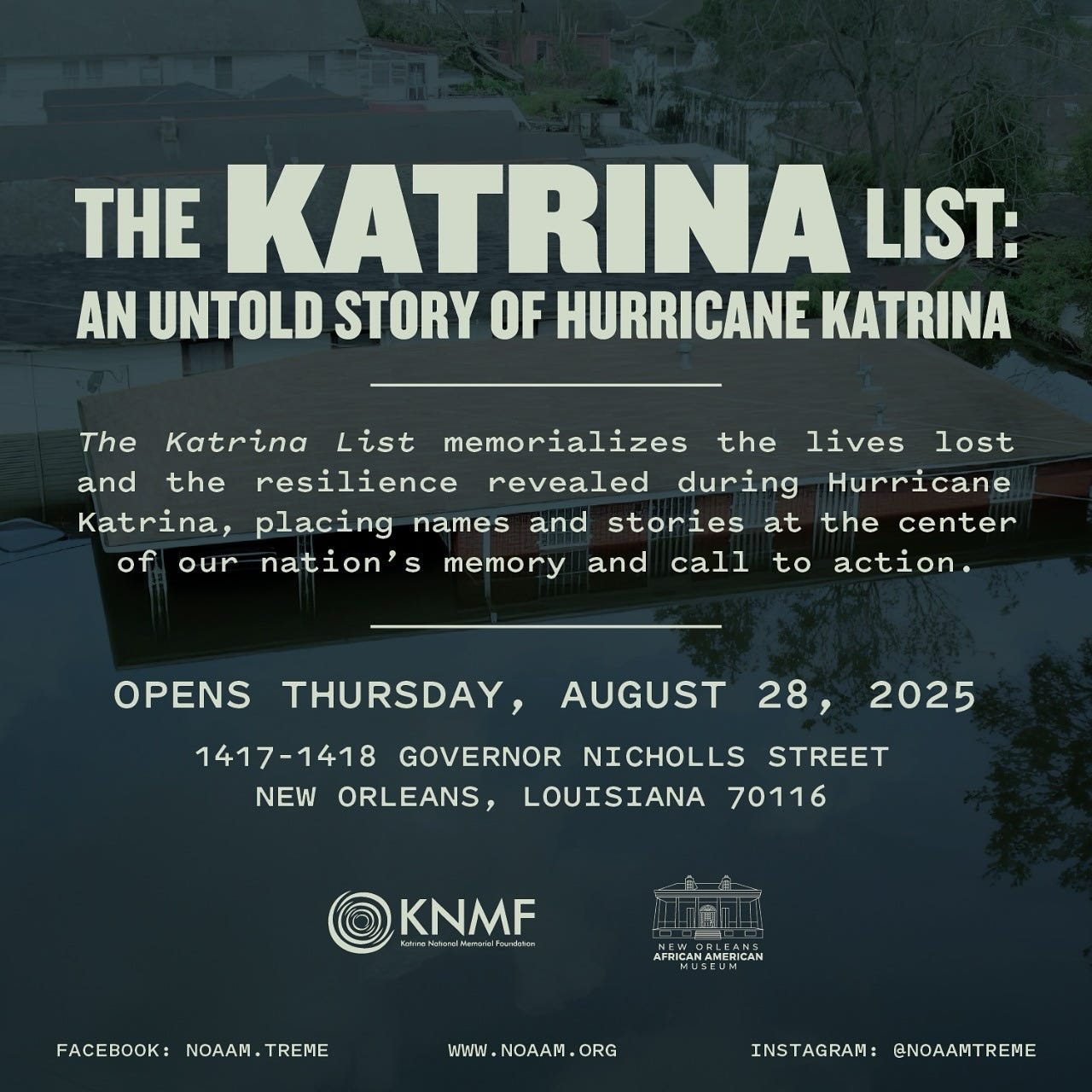
“On my first day back in New Orleans after Katrina, I returned to my childhood home. I sat in the front seat of the U-Haul with my back turned. I didn’t get out; I didn’t look at the house that day. I regret it. The only thing my family salvaged from my room was a ceramic Virgin Mary my great-aunt had fired and given to my mother and me. I think about my great-aunt and her lifetime of work stolen by that water, in new ways trying to assess what my own life has “amounted to” in the 20 years since. The last 20 years are a disparate archive of living and writing. Running from storms, leaving and returning. The last 10 years, I built shrines, altars in public and private, and became a performance artist to work out what words can’t articulate. I also look back at friends and relationships lost in the whirlwind of trying to remake ourselves.”
- Kristina Kay Robinson, What We Lost After Katrina, https://www.harpersbazaar.com/culture/features/a65810072/new-orleans-katrina-anniversary/
For more:
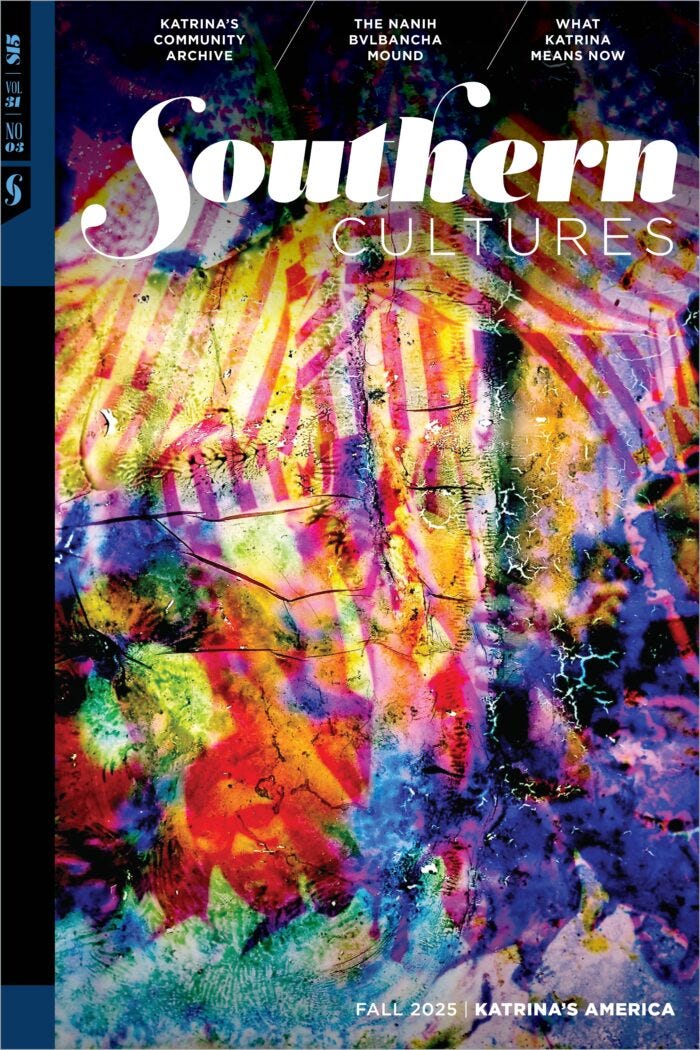
Katrina’s America, special issue of Oxford American, https://www.southerncultures.org/issues/katrinas-america/
Elise Plunk, “Since Katrina, Infrastructure Shortcomings Create Resiliency Fatigue • Louisiana Illuminator,” Louisiana Illuminator, August 26, 2025, https://lailluminator.com/2025/08/26/katrina-resiliency/.
Midlo Center at UNO digital exhibit and commemoration: katrina20.midlocenter.org
Glen Ford, “No Black Plan for the Cities, Despite the Lessons of Katrina,” Black Agenda Report, October 3, 2007, https://web.archive.org/web/20071003025329/http://www.blackagendareport.com/index.php?option=com_content&task=view&id=210&Itemid=33.
Barbara Ransby, “KATRINA, BLACK WOMEN, AND THE DEADLY DISCOURSE ON BLACK POVERTY IN AMERICA,” Du Bois Review: Social Science Research on Race 3, no. 1 (2006): 215–22, https://doi.org/10.1017/S1742058X06060140.
Richard Campanella, “In Light of the Brian Williams Katrina Controversy: A Brief History of French Quarter Flooding | Home/Garden | Nola.Com,” NOLA.Com, February 10, 2015, https://www.nola.com/entertainment_life/home_garden/in-light-of-the-brian-williams-katrina-controversy-a-brief-history-of-french-quarter-flooding/article_c4d32f8c-187f-5e01-b64e-4459c569a4c2.html.
Clyde Woods, Development Drowned and Reborn: The Blues and Bourbon Restorations in Post-Katrina New Orleans (University of Georgia Press, 2017).
Jessica Marie Johnson, “Black New Orleans is the Center of the World,” Journal of African American History (2018) https://www.jstor.org/stable/48570698