Digital Alchemy Against Misogynoir (Black Creative Worlds: Week Five)
In which Moya Bailey reminds us that Black queer and trans imagination created the internet we knew and loved, even if credit is rarely given where it is due.

Black Creative Worlds is a community offering of notes, readings, and curriculum from my convening of Black World Seminar in Spring 2025. Newsletters come out on Mondays from now through April with material for free and paid subscribers under the paywall jump.
For more on the Black World, including past seminar schedules and an essay about the Black World Seminar by Dr. Nathan Connolly visit: bit.ly/JHUBlackWorld.
I count myself fortunate to live in a time of genius. Moya Bailey might not describe herself that way, and she is clear, in Misogynoir Transformed, that the term misogynoir may have originated with her, but it was also incubated in work generated and further theorized by Trudy of Gradient Lair. Together, they published a history of the term. But who said two people can’t be geniuses? Who said twenty?
The lesson of Misogynoir Transformed is it takes community to create remedies against oppression and that community is the remedy against representations that threaten to destroy us. Genius is plural and communal. Black feminists have been teaching us this lesson since Harriet Jacobs sat in the loophole of retreat provided by her grandmother’s garret to watch her children play. Kinship is a practice and it is the medicine.
Even when the disease is epidemic. I followed Trudy for years and years, knowing that I was learning from a singular mind. I still support their work, although I won’t do more than say their name here, because the other lesson of Misogynoir Transformed is that creating generative digital worlds that center Black queer and trans folks as complex human beings worthy of care, grace, and cherishing may alchemize racism, sexism, classism, ableism, and transphobia, but it does not dismantle empire.
Trudy has described elsewhere the damage researchers, academics, and journalists have done just by linking to her work and putting her ideas in their own creations. And if there’s anything the last 28 days have taught us, it is that these platforms never loved us, we just loved the shit out of each other with them as tools, as front stoops, and as windows we could shout down to each other form.
The point, as Mark Anthony Neal reminds me constantly, was never the platform.
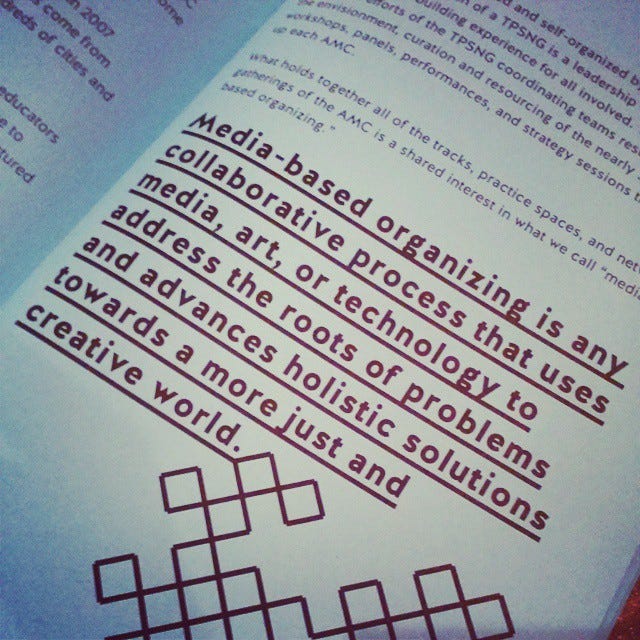
Trudy’s digital project (more than a blog!), Gradient Lair, has sunset. Most of the web series Bailey describes have also sunset. Tumblr is somewhere in the Land of Lost Toys. AMC has sunset and remixed its focus to Detroit. And on and on.
The permanence of the work was never the point (although some of the artists, writers, and creatives Bailey references may have preferred to stick around longer than they did). Ephemerality has never stopped Black queer and trans folks, feminist-identified and otherwise, from creating new worlds. We create because we have to. Because without cultivating an erotic, resistive, transgressive, audacious and juicy imagination, how else will we survive?
As web pages get deleted and data sets disappear, as a new administration attempts to literally write and legislate trans folks out of existence, harnessing the power of memory, fighting for what can be said and what needs to be said, and creating worlds where we, Black queer folk, don't disappear, where our trans sisters and trans and non-binary sibs don't disappear—this is the work. This is what digital alchemy teaches us to do.
Discussion questions and suggested readings below (updated with more texts specific to Black trans studies); activity and more of my thoughts below the paywall.
What We Are Reading
Moya Bailey, Misogynoir Transformed: Black Women’s Digital Resistance (New York: NYU Press, 2021).
“Abolition is Fractal,” Andrea Ritchie, Practicing New Worlds: Abolition and Emergent Strategies (La Vergne: AK Press, 2023).
Discussion Questions
What is misogynoir and how does Bailey define it?
What is a zine and how does it work?
What is a hashtag and how does it work?
Were you outside for the era of Black web series? Did you watch the ones Bailey describes?
Timeless question: What do we do with representations that aren’t so “favorable” or put Black folks in the best light?
Does the fractal require permanence? What do we do with the missing websites, the sunset projects, the disappeared platforms and the work created on them?
How does autobiography and controlling, creating, and repairing the narrative of who you are intersect with finding community online for Black queer and trans folks?
Who is making the Black queer and trans content that you love now? Is there a lesson in Bailey about how to support, celebrate, even critique the work that brings more community, connection and creation into the world, not less?
Once again, Allied Media Conference takes center stage. How have the books so far crossed paths with each other—not just in topics and scholars, but in other ways?
Suggested Readings
C. Riley Snorton, Black on Both Sides: A Racial History of Trans Identity (Minneapolis: University off Minnesota Press, 2017).
Treva Ellison, Kai M. Green, Matt Richardson, and C. Riley Snorton, “We Got Issues Toward a Black Trans*/studies,” TSQ: Transgender Studies Quarterly 4(2017): 162–69.
Kaila Adia Story, “Fear of a Black Femme: The Existential Conundrum of Embodying a Black Femme Identity While Being a Professor of Black, Queer, and Feminist Studies,” Journal of Lesbian Studies 0(2016): 1–13.
Uri McMillan, Embodied Avatars: Genealogies of Black Feminist Art and Performance (New York: NYU Press, 2015).
Jessica Marie Johnson, “4dh + 1 Black Code / Black Femme Forms of Knowledge and Practice,” American Quarterly 70, no. 3 (2018): 665–70.
Savannah Shange, “A King Named Nicki: Strategic Queerness and the Black Femmecee,” Women & Performance: a journal of feminist theory 24, no. 1 (2014): 29–45.
Omise’eke Natasha Tinsley, Ezili’s Mirrors: Imagining Black Queer Genders (Durham: Duke University Press Books, 2018).
Omise’eke Natasha Tinsley, The Color Pynk: Black Femme Art for Survival (Austin: University of Texas Press, 2022).
Margaret Washington, Sojourner Truth’s America (Chicago: University of Illinois Press, 2009).
Washington, Margaret. “Going ‘Where They Dare Not Follow:’ Race, Religion, and Sojourner Truth’s Early Interracial Reform.” The Journal of African American History 98, no. 1 (January 1, 2013): 48–71.
Kidada Williams, “Interview: Deborah Willis | Seizing Freedom,” August 27, 2021, https://seizingfreedom.vpm.org/interview-deborah-willis/.
Kim Gallon, “The Media Force That Made ‘Black Twitter’ Possible,” The Washington Post, February 11, 2016, https://www.washingtonpost.com/opinions/the-media-force-that-made-black-twitter-possible/2016/02/11/092ed5c6-af1d-11e5-b820-eea4d64be2a1_story.html.
Tina Campt, “The Loophole of Retreat--An Invitation,” E-Flux 105 (2019), https://www.e-flux.com/journal/105/302556/the-loophole-of-retreat-an-invitation/.
Kim Gallon, “Looking Backward and Forward: Pleasure, Joy, and the Future of Black DH,” Digital Humanities Quarterly 016, no. 3 (July 22, 2022).
Legacy Russell, Black Meme: A History of The Images That Make Us (Verso, 2024)
Tina M. Campt, A Black Gaze: Artists Changing How We See (The MIT Press, 2021)
Tina M. Campt, Listening to Images (Durham: Duke University Press Books, 2017).
“Tourmaline. Salacia. 2019 | MoMA,” The Museum of Modern Art, accessed February 17, 2025, https://www.moma.org/audio/playlist/298/4089.
Alexis Pauline Gumbs, M Archive: After the End of the World, Illustrated edition (Durham ; London: Duke University Press Books, 2018).
The Black Studies Podcast, “Romaine McNeil, Tatiana Esh, Sha-Shonna Rogers, Jessica Newby, and Julia Mallory - Slavery in Motion Collection, Baltimore Museum of Art,” Substack newsletter, The Black Studies Podcast (blog), February 6, 2025
Sarah J. Jackson et al., #HashtagActivism: Networks of Race and Gender Justice (Cambridge: The MIT Press, 2020).
“The Digital Apothecary with Moya Bailey,” The Emergent Strategy Podcast, n.d.,
.