

Ask me: what do i remember?
What do I remember?

Horses big, brown, tired, seeing
too much between the trees. i remember

to put the blackberries in a jar, taste
with smashed fingers, remember

their breaking, the wet mud, slick.
Eighteen sixty three, remember?

"God damned Yankee army," he'd hissed
while i prayed black and remembered

red watermelon flesh, fresh cut grass, smelled
pistol-blood on leather that remembers

three years isn't long enough.
(But the shame is not mine. Remember.)
On March 3, 1865, Congress established the Bureau of Refugees, Freedmen, and Abandoned Lands. The “Freedmen’s Bureau” was a critical resource for ex-slaves as they battled ex-Confederate soldiers, former owners, planter legislatures, and extra-legal violence. The Freedmen’s Bureau assisted formerly enslaved women, children and men with emergency food, clothing, medical care and education. They mediated labor disputes, criminal disputes between freedpeople and between freedpeople and their owners, and civil ceremonies like weddings.
The Freedmen and Southern Society Project has worked for years to make the massive documentation generated by formerly enslaved available for all to see, read, research, and learn from. Learn more here.
On September 25, 1866, just three years after the Emancipation Proclamation, Rhoda Ann Cody “came into this office” of the Freedmen’s Bureau in Griffin, Georgia and delivered testimony about a brutal rape by eight soldiers that occurred at her house, while her husband “had gone to the watermelon patch.” At least one man, she “supposed to be an ex-Confederate soldier,” because he was on crutches. They threatened to kill her because her husband fought for the Union Army. The the men beat her daughters, ransacked their cabin, stole clothing and other items, and left. “There were concerned in this affair eight men,” she stated, “none of which could be recognized, for certain.”
Recognizable or not, Black women seized the right of testimony where it was available. And whether it yielded safety or not, Black women demanded their story would be told. And whether officers believed them or not, whether it was safe to tell or not, they were determined to be heard.
This offering is for the power of testimony. And memory.
I offer a ghazal, a form of poetry that has a tradition of love and loss, to struggle with what love means in a world of slaves, what love means in the afterlife of slavery, with loving Black womanhood and mourning the suffering that stalks us and loving how we give testimony anyway. With the five senses of the body (see, touch, hear, taste, smell) and what it takes to be in our bodies despite and because and in the face of.
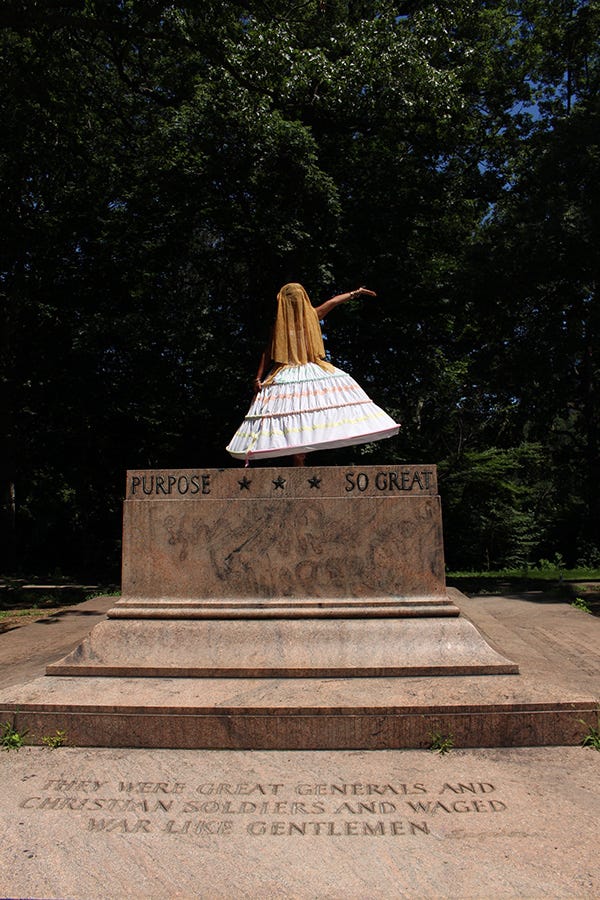
Ada Pinkston, artist and cultural worker, created the performance piece pictured to reconsecrate sites of Confederate monuments around Baltimore City. The LandMarked project is at the link.
May light lift up the souls and spirits of Rhoda Ann Cody, but also Cerina Fairfax, Shaneiqua Pugh, Nancy Metayer Bowen, Lisa Grier, Barbara Deer, the many named and unnamed.
We remember and will remember. The shame is not yours.
Texts:
Brittney Cooper, “The Shreveport Mass Killing Isn’t Just About ‘Mental Health,’” The Cut, April 20, 2026, https://www.thecut.com/article/shreveport-killing-shamar-elkins-mental-health-patriarchy.html.
Yomaira Figueroa-Vásquez and Jessica Marie Johnson, “Hoodrat Praxis in a Time of Love and Fury,” in More Than Our Pain: Affect and Emotion in the Era of Black Lives Matter, ed. Beth Hinderliter and Steve Peraza (SUNY Press, 2021).
Treva B. Lindsey, America, Goddam: Violence, Black Women, and the Struggle for Justice, (University of California Press, 2023).
Emily A. Owens, Consent in the Presence of Force: Sexual Violence and Black Women’s Survival in Antebellum New Orleans (The University of North Carolina Press, 2023).
This is offering #11 of Stitch Open My Eyes a 12-week community offering on history and memory in slavery’s archive. Because the Black freedom struggle during slavery should be a topic of conversation at every kitchen table. Follow along by subscribing above.