
haunting my creative pursuits + research post + some other updates 2025-10-31
Ghosts in my machine this Halloween

I don’t know what it is, but I find myself haunting old projects, photos, and trains of thought this week. I spent more than a little time down a digital designer rabbit hole (eventually meandering through Figma and Cargo collective) and I ended up right where I began years and years ago: good old Twine.
I originally started this particular Twine project as a contribution to the Open Classroom for New Orleans Culture, an NEH-funded project led by Bryan Wagner and in collaboration with the Neighborhood Story Project. The Open Classroom created a library of open access resources on New Orleans history, music, people, and events for teachers to access. (We shared about this project during the week of support for the NEH last spring and the full list of resources is maintained by University of CA-Berkely)

I don’t know what is making me return to it now except a deep desire to get back to basics, back to what excites me about using digital tools, about creating, and about connection—including connecting the past to the present and beyond. So much is shitty right now, so much hurt is being dished out by people with a lot of power and very little imagination. We must all do what we can, wherever we can and think in big-small ways about our impact (ex. Shout out to Dems holding the line on this shutdown, HOLD THE LINE, and/also SNAP is about to be cut off for many people across our neighborhoods, schools, and jobs—now is the time to start giving money, food or time to food banks).
While we are doing it, finding joy, pleasure, and pretty things to do also feels important right now. Pretty, tingling, tinkering with things.
In the book I am working on now, there are parts where I try to remember, walk my body back into a smaller one, a younger one, a Black girl who had more in common with my daughter than with this baby elder typing words on screens today. Pink Oil on an out of the box relaxer and too short bangs. But joy, play and connection is what always pulled me back to the computer as a kid, that strange plastic box and the yellow AOL man who ran across it.
This Halloween, I am dressing up as Cinderella, Queen of Ashes, Sweet Dancing, and Fairy Godmothers. I have flowers for the altar. And below there a list of things for y’all to read and fly back in time with too. Who knows what (or who) you’ll see you’re back there, but sometimes nostalgia can be a secret weapon that keeps the muses humming. I’m going to go with it for now.
Projects
Brenda Torres-Figueroa, Dressed as Home and Refuge: https://sites.google.com/view/performatum/dressed-as-home-and-refuge?authuser=1
The Complete Performances of Zora Neale Hurston from the Florida Folklife Collection: https://www.floridamemory.com/discover/audio/playlists/dust_tracks.php
Watch
Reads
Yafrainy Familia, “Curating Transnational Feminist Solidarities in Born in Flames: Feminist Futures,” Meridians 24, no. 2 (2025): 357–78, https://doi.org/10.1215/15366936-11864081.
John W. Blassingame, “The Mathematics of Slavery,” The Atlantic Monthly (1971-1981); Boston, August 1974.
John W. Blassingame, “Black Autobiographies as History and Literature,” The Black Scholar 5(1973): 2–9.
Anna Julia Cooper “The Third Step (Autobiographical)” (2017). Manuscripts and Addresses. 24. https://dh.howard.edu/ajc_addresses/24
Mayra Santos-Febres, “La Memoria De Mi Madre,” Hispanófila, no. 189 (2020): 71–84.
Christina Sharpe, Monstrous Intimacies: Making Post-Slavery Subjects (Durham, NC: Duke University Press, 2009).
“Universities as Political Battlegrounds, A Call for Courage,” Scholars For Social Justice, accessed June 13, 2025, https://www.scholarsforsocialjustice.com/universities-as-political-battlegrounds.
Michael A. Gomez, Exchanging Our Country Marks: The Transformation of African Identities in the Colonial and Antebellum South (Chapel Hill: The University of North Carolina Press, 1998).
Harry Haywood, Negro Liberation (Haymarket Books, 2026).
Miriam Jiménez Román and Juan Flores, The Afro-Latin@ Reader: History and Culture in the United States (Duke University Press, 2010).
Silvio Torres-Saillant, “Introduction to Dominican Blackness,” Publications and Research, January 1, 2010, https://academicworks.cuny.edu/dsi_pubs/3.
Mimi Onuoha and Mother Cybory, A People’s Guide To Ai (Artificial Intelligence) (Allied Media Projects, 2018), https://alliedmedia.org/resources/peoples-guide-to-ai.
Arthur A. Schomburg (Arturo Schomburg), “The Negro Digs Up His Past” (1925)
Lumarhi J. Rivera Lozada, “REPRESENTACIÓN DE LA NEGRITUD COMO ARMA EN LA LUCHA POR LAS MUJERES,” Revista Étnica, n.d., accessed August 30, 2025, https://www.revistaetnica.com/blogs/news/representacion-de-la-negritud-como-arma-en-la-lucha-por-las-mujeres.
Nadia Roche et al., “Introduction from the Editors: Women of Color (WOC) in Collaboration and Conflict Witnessing and Testimony: Hurt, Healing, and Herstories,” Witnessing and Testimony: Hurt, Healing, and Herstories 1, no. 1 (2019), https://escholarship.org/uc/item/9081r337.
”Who Lives in New Orleans and Metro Parishes Now?,” The Data Center, October 6, 2023, https://www.datacenterresearch.org/data-resources/who-lives-in-new-orleans-now/.
Barbara Smith, “A Press of Our Own Kitchen Table: Women of Color Press,” Frontiers: A Journal of Women Studies 10, no. 3 (1989): 11–13, https://doi.org/10.2307/3346433.
Barbara Smith, “Toward a Black Feminist Criticism,” The Radical Teacher, no. 7 (1978): 20–27.

Updates
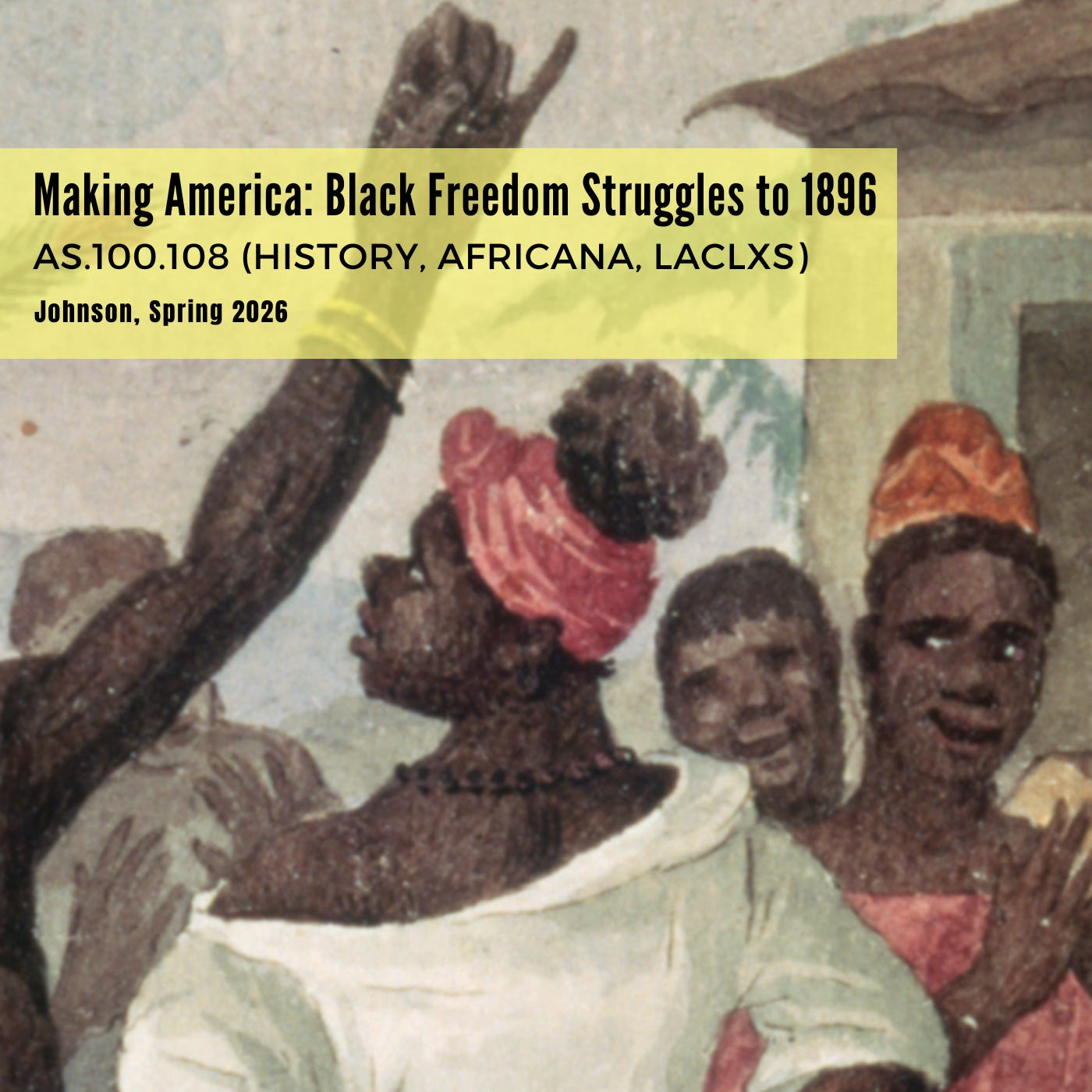
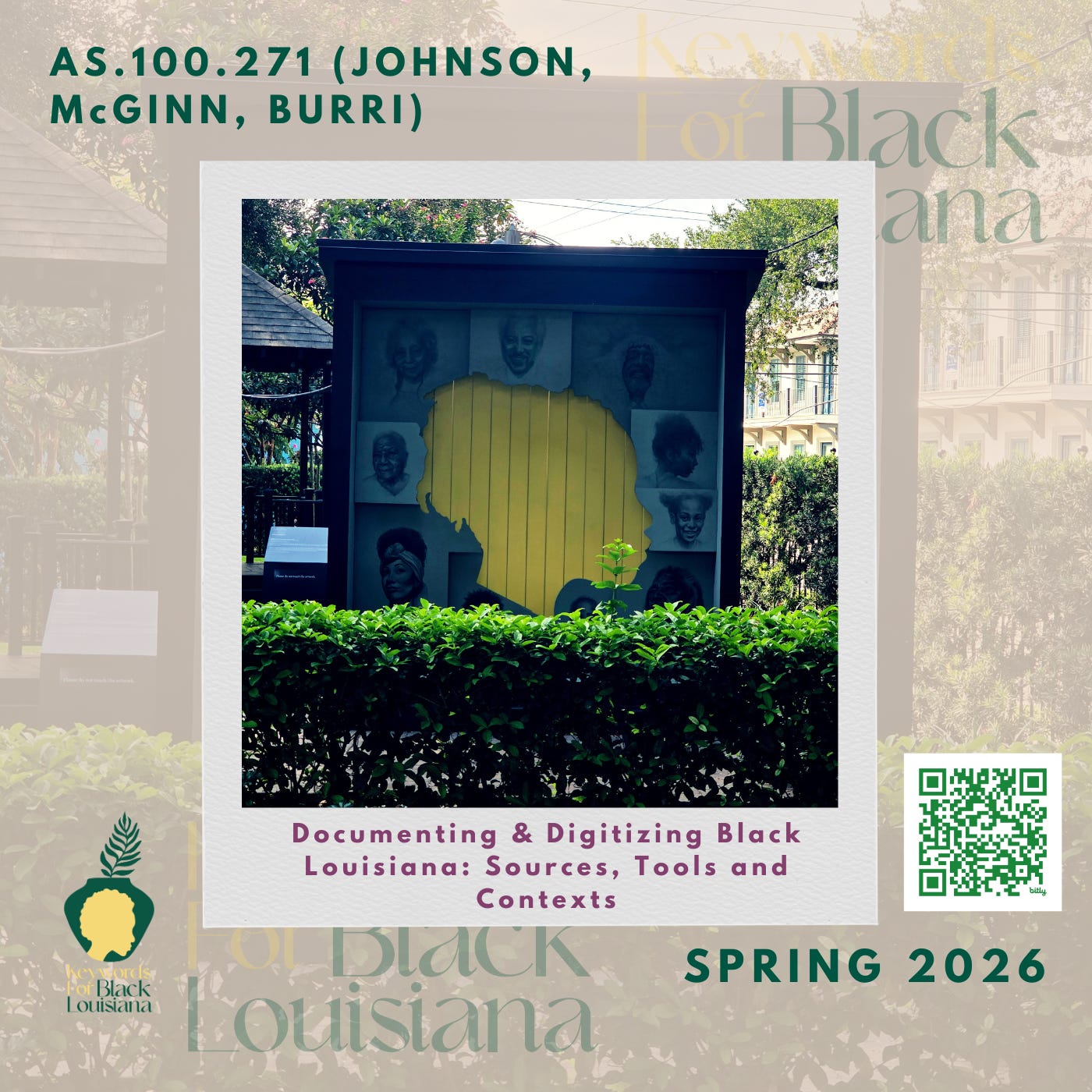
Spring 2026 courses are live. I’m looking forward to crafting community offerings for each of these over the next few months (for an example of these, check out Black Creative Worlds). In these times (sip), teaching the history of slavery with Black life and humanity at the center is a charge and a mission.
We hold the line and the stakes are high.
Lagniappe
Just a thought, that I hope can become a refrain:
I never write anything with the help of Ai. I wish it would stop intruding on my screen and fighting for my attention. I never say yes, I turn it off wherever I can. I find it offensive and non-consensual. And KTH has no editor. Just me, throwing some words on a page and then onto a screen.
But that also means there are typos, trailing thoughts, and other typographical scrimmage.
I used to hate typos. I used to snicker at them when I saw them in people’s writing. Now I value them as proof of humanity. Of embracing our mess and our mistakes.
So those typos are going to stick around. Consider them proof of my humanity—proof that I am, indeed, a real Black gyrl.