
Parables (Black Creative Worlds, Week Eight)
"...history is another planet" - Octavia Butler

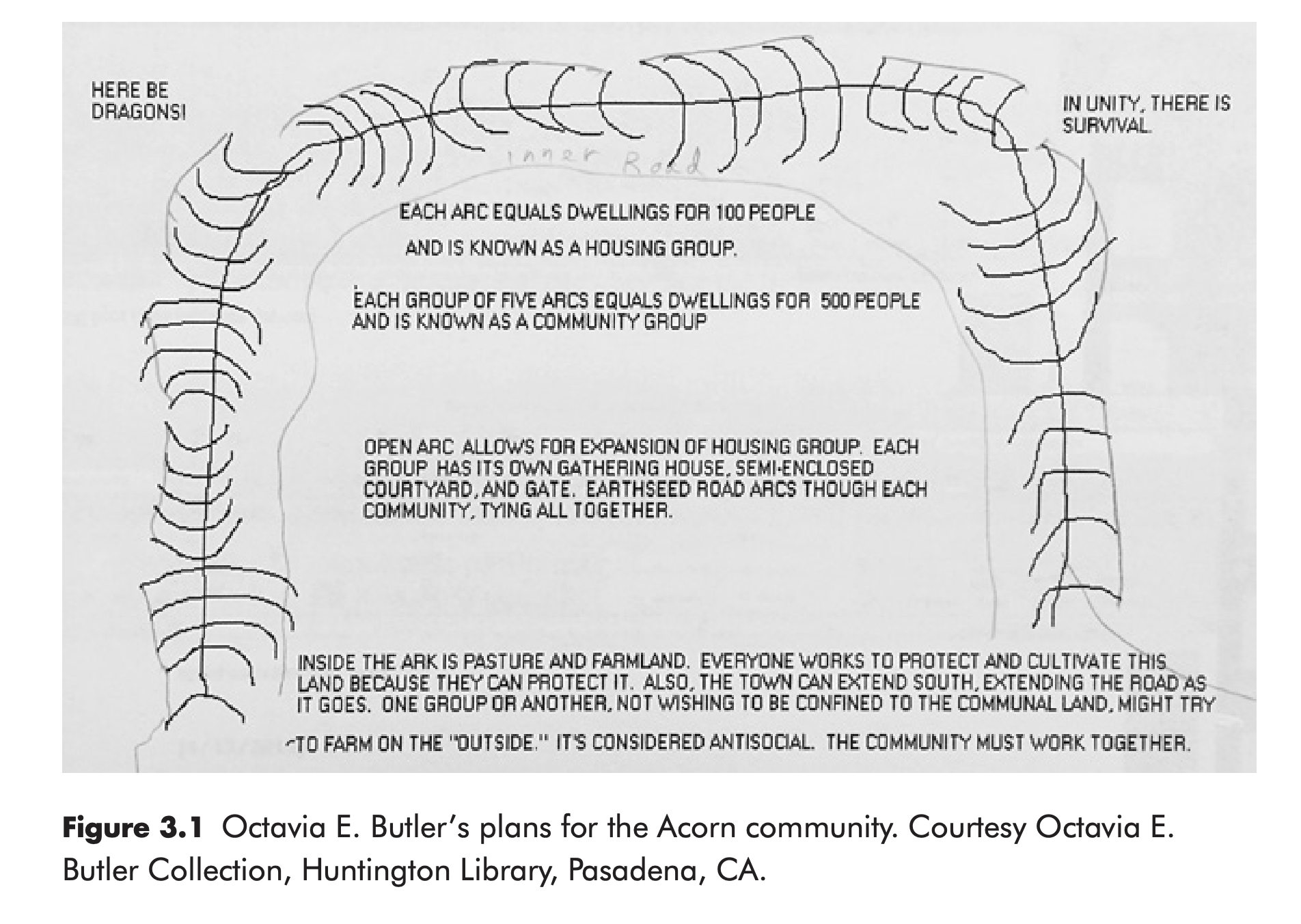
My obsession with Octavia Butler predates all other obsessions except my obsession with history. I am writing about her in the book I am working on, including my first encounter with her—which was Parable of the Sower at age thirteen. I write to her whenever I journal, even when I am not writing directly to her. And my relationship with her work is usually different from most people. Parable of the Sower is the Bible, of course. But Wild Seed is still my favorite, the one I think offers me the clearest map of where we have been and where we might go. Might, of course, since the Patternmaster series does not end up in the softest place. But the potential energy of “might” is the same potential energy of a parable and anyone familiar with the winding cautionary tales of African diasporic religions and folklore will recognize in Wild Seed a story of the humbling of two gods and the making of a world.
Wild Seed like both Parables is a warning, a possibility, not a prophecy. Wild Seed is just a longer yarn.
But what a warning it is. Parable of the Sower gives us Acorn. Parable of the Talents takes it away. And in the journey, we are meant to be warned of something, to be careful about something, to learn something. Given we are in the end game now, in the actual saga that Parables laid out, with people being disappeared, we have a lot to be warned of, a lot to be careful of, and a lot to learn.
More from me below the paywall jump, but if you’ve been following, you got a prelude of Butler two weeks ago, that you can review here.
Octavia E. Butler, 1947-2006 (A Black Creative Worlds Prequel)

Black Creative Worlds is a community offering of notes, readings, and curriculum from my convening of Black World Seminar in Spring 2025. Newsletters come out on Mondays from now through April with m…
What We Are Reading
Octavia Butler, Parable of the Sower &
Octavia Butler, Parable of the Talents
“Abolition is Nonlinear and Iterative,” Andrea Ritchie, Practicing New Worlds: Abolition and Emergent Strategies (La Vergne: AK Press, 2023).
Suggested Readings:
Octavia’s Parables Podcast, chapter 1, https://www.readingoctavia.com/episodes/sower-e1
Gerry Canavan, “‘There’s Nothing New / Under The Sun, / But There Are New Suns’: Recovering Octavia E. Butler’s Lost Parables,” Los Angeles Review of Books, June 9, 2014, https://lareviewofbooks.org/article/theres-nothing-new-sun-new-suns-recovering-octavia-e-butlers-lost-parables/.
Ruha Benjamin, “But … There Are New Suns!”,” Palimpsest: A Journal on Women, Gender, and the Black International 6, no. 1 (2017): 103–5.

Discussion Questions (expect spoilers, of course)
What role does faith play in the work you do? Not necessarily in a Judeo-Christian sense, but is there some intangible that you have faith in that orients you? Even if you don’t know it?
What role does religion play in the work you do? Even if a contrarian role?
The Parables are Judeo-Christian parables. Olamina’s father is a minister. Butler’s mother was very religious as well. How does Black Christianity in particular, and its history, appear in this future-not-future world?
How do you write about violence? Butler doesn’t shy away from any violent experiences and, in fact, imagines terror that we don’t have in our world yet. Thoughts on writing violence and how. And why.
By Parable of the Talents, Lauren Olamina and Harry and Zahra aren’t the only survivors of their community. Marcus returns and his re-entry is rough. What can we learn from Marcus’s arrival about re-entry, re-learning, unlearning as we build community and solidarity in this world?
Children in this world, in both books, have particular experiences. What do we learn about childhood in Parables?
Radical empathy is a common science fiction (fantasy, speculative fiction, etc.) device. From Charmed to Professor X, it isn’t uncommon to come across characters who can feel deeply what others feel. But usually they can control it (or their journey is to learn to control it). Olamina will never be able to control her hyperempathy. It is a a disability. In the hands of their oppressors, it even becomes a tool of oppression and unspeakable (though Butler speaks it) violation. Are there abilities and disabilities that operate in similar ways in your world?
Related — Are social media companies creating hyperempathy in us and then using it as a tool against us?
Christian fundamentalism is introduced in Sower but Christian AmericaTM is unfurled in Talents. What do we learn about how Christian America runs, its structure, members, businesses, leaders? What parallels do we see as we look around today?
Do they make it to the stars? What is the lesson of going (or not going) to the stars?
Lauren is a mother, by the end, but her motherhood is fraught, maybe even broken. What is Black motherhood in Parables?
What is Black love in this world?
Suggested Readings
Going to try to keep this short, but there is so much!
Gerry Canavan, Octavia E. Butler, Illustrated edition (Urbana: University of Illinois Press, 2016).
Jayna Brown, Black Utopias: Speculative Life and the Music of Other Worlds (Duke University Press, 2021)
Susana M. Morris, “Black Girls Are from the Future: Afrofuturist Feminism in Octavia E. Butler’s Fledgling,” WSQ: Women’s Studies Quarterly 40, no. 3 (2012): 146–66.
Lynell George, A Handful of Earth, A Handful of Sky: The World of Octavia Butler (Santa Monica, California: Angel City Press, 2020).
Sami Schalk, Bodyminds Reimagined: (Dis)Ability, Race, and Gender in Black Women’s Speculative Fiction (Duke University Press, 2018).
Abby Aguirre, “Octavia Butler’s Prescient Vision of a Zealot Elected to ‘Make America Great Again,’” The New Yorker, July 26, 2017, https://www.newyorker.com/books/second-read/octavia-butlers-prescient-vision-of-a-zealot-elected-to-make-america-great-again
Sasha Ann Panaram, “Bloom’s Butler’s Taxonomy,” The Black Scholar 52, no. 2 (April 3, 2022): 38–49, https://doi.org/10.1080/00064246.2022.2042762
Octavia E. Butler, A Few Rules for Predicting the Future: An Essay (Chronicle Books, 2024)
Moya Bailey, “‘ Shaping God’: The Power of Octavia Butler’s Black Feminist and Womanist SciFi Visions in the Shaping of a New World–An Interview With Adrienne Maree Brown,” 2013, https://scholarsbank.uoregon.edu/xmlui/bitstream/handle/1794/26298/ada03-shapi-bai-2013.pdf?sequence=1
Betsy Mitchell, “The Evolution of Octavia Butler’s Cover Art,” The Portalist (blog), June 5, 2019, https://web.archive.org/web/20190605051627/https://theportalist.com/octavia-butler-cover-art
Ayana Jamieson, “‘Harvest of Survivors’: 30 Years After Octavia E. Butler’s ‘Parable of the Sower’ | Sierra Club,” Sierra: The Magazine of the Sierra Club, February 22, 2023, https://www.sierraclub.org/sierra/harvest-survivors-30-years-after-octavia-e-butler-s-parable-sower.
Frances Smith Foster, “Octavia Butler’s Black Female Future Fiction,” Extrapolation 23, no. 1 (Spring 1982): 37–49.
Marisa Parham, “Saying ‘Yes’: Textual Traumas in Octavia Butler’s ‘Kindred,’” Callaloo 32, no. 4 (2009): 1315–31
Moya Bailey and Ayana A. H. Jamieson, “Guest Editors’ Introduction: Palimpsests in the Life and Work of Octavia E. Butler,” Palimpsest: A Journal on Women, Gender, and the Black International 6, no. 1 (2017): v–xiii, https://doi.org/10.1353/pal.2017.0014.
Octavia Butler, “Locus Online: Octavia E. Butler Interview (Excerpts),” June 2000, http://www.locusmag.com/2000/Issues/06/Butler.html.
“Black Blessings: Toni Cade Bambara and Octavia E. Butler,” The Feminist Wire (blog), accessed November 23, 2014, http://thefeministwire.com/2014/11/black-women-writers/
TAPPhD, “Digging in the Crates: Day 4 in the Octavia Butler Archives at The Huntington | Therí A Pickens, PhD,” accessed November 5, 2014, http://www.tpickens.org/2014/11/04/digging-in-the-crates-day-4-in-the-octavia-butler-archives-at-the-huntington/.
Radio Imagination https://clockshop.org/project/radio-imagination/
“In biological terms, her most frequent metaphor is not individualistic competition but mutual interdependence: symbiosis. We need the Other to live (whether we like it or not).” - Gerry Canavan, Octavia E. Butler, Illustrated edition (Urbana: University of Illinois Press, 2016)