
research post 2026-02-13
Tra tra babee and throw me something

A happy week, a happy weekend, a happy next week to all. Joy to keep us ready for the work, play so we remember what we are doing the work! If there’s no dancing in the next world, I don’t care how revolutionary y’all tell me it is—I don’t want it!!!
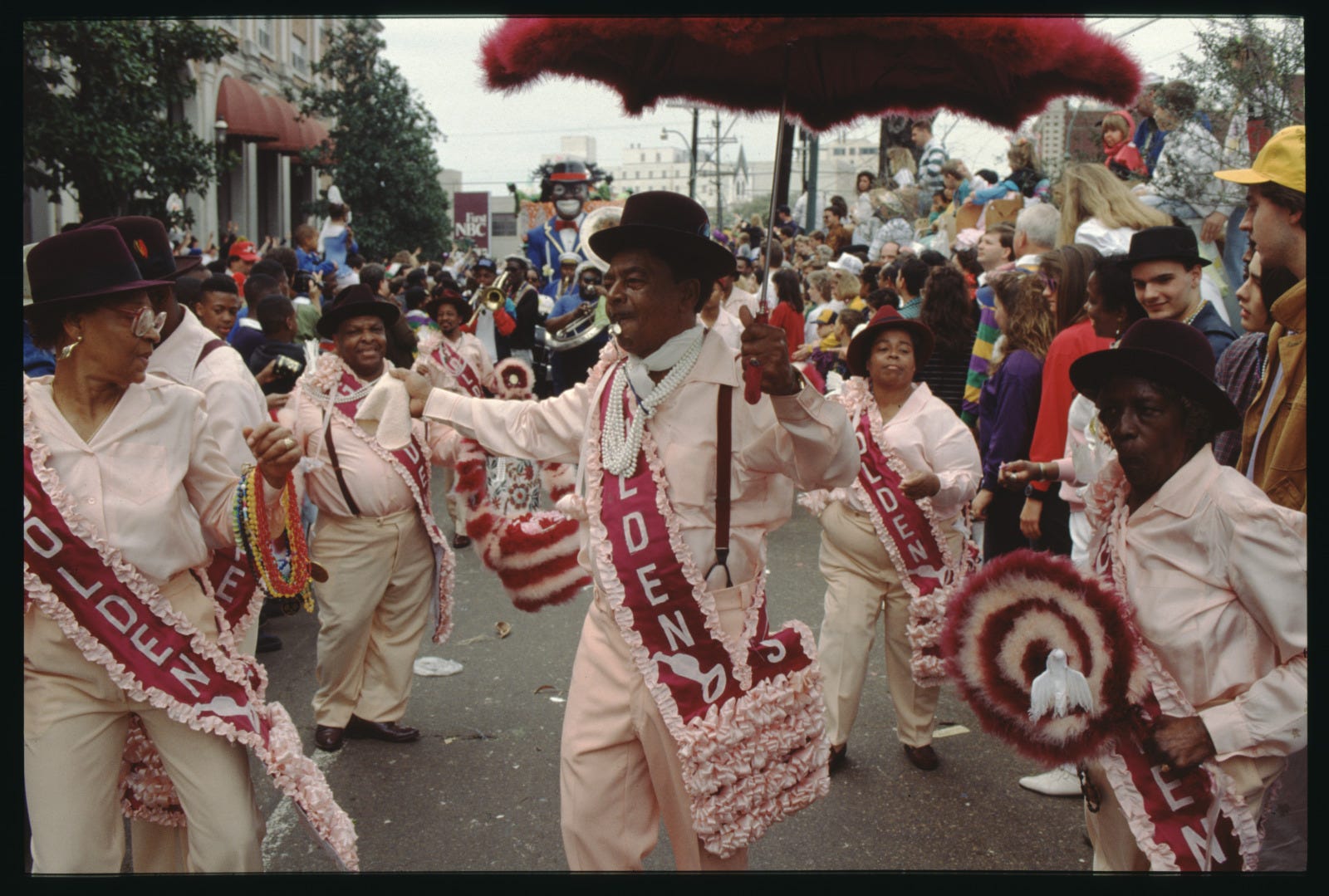
Happy Deep Gras, Lundi Gras and Mardi Gras to all who celebrate!
Listen
“How Bad Bunny Took Puerto Rican Independence Mainstream,” Throughline, NPR, February 12, 2026, https://www.npr.org/2026/02/12/nx-s1-5708997/how-bad-bunny-took-puerto-rican-independence-mainstream.
Reads
Dr Katherine Jarvie-Dolinar, Radical Recordkeeping, February 18, 2025, https://rmit.pressbooks.pub/archivingvoicesofchange/chapter/radical-recordkeeping/
Mayra Santos-Febres, Antes que llegue la luz (Planeta, 2021)
Aliyyah I. Abdur-Rahman, Millennial Style: The Politics of Experiment in Contemporary African Diasporic Culture (Duke University Press, 2024).
“Ben Okri on Ayuba Suleiman Diallo: A Dialogue across Time - National Portrait Gallery,” accessed February 3, 2026, https://www.npg.org.uk/whatson/display/2013/ben-okri-on-ayuba-suleiman-diallo-a-dialogue-across-time.
Frances Negrón-Muntaner, “‘Here Is the Evidence’: Arturo Alfonso Schomburg’s Black Countervisuality,” African American Review 54, no. 1 (2021): 49–71;
Lisa Herndon, “1924: A Year in the Life of Future Schomburg Center Founder Arturo Schomburg,” The New York Public Library, accessed February 6, 2026, https://www.nypl.org/blog/2024/01/03/1924-year-life-future-schomburg-center-founder-arturo-schomburg?aff=nyplblog
Lisa Herndon, “A Look at Arturo Schomburg’s Essay, ‘The Negro Digs Up His Past,’ 100 Years Later,” The New York Public Library, accessed February 6, 2026, https://www.nypl.org/blog/2025/03/04/look-arturo-schomburgs-essay-negro-digs-his-past-100-years-later
“History,” The New York Public Library, accessed February 6, 2026, https://www.nypl.org/node/31426.
“Schomburg Center Opens in New York,” The Afro American (Baltimore), October 11, 1980, https://news.google.com/newspapers?id=tSkmAAAAIBAJ&dq=schomburg%20center&pg=6299%2C1405282.
Eve Tuck, Mistinguette Smith, Allison M. Guess, Tavia Benjamin, Brian K. Jones, “Geotheorizing Black/LandContestations and Contingent Collaborations,” Departures in Critical Qualitative Research 3, no. 1 (2014): 52–74, https://doi.org/10.1525/dcqr.2014.3.1.52.
Allison M. Guess and Sarah Soanirina Ohmer, “Reappraising Land And Inheritance, Revisiting Ghosts: A Black Feminist And Decolonial Land-Informed Reading Of Beloved by Toni Morrison And I, Tituba, Black Witch Of Salem by Maryse Condé,” Feminist Formations 36, no. 1 (2024): 27–56.
Eve Tuck and Allison Guess, “Collaborating on Selfsame Land,” in Deterritorializing/Reterritorializing Critical Geography of Educational Reform (Brill, 2017), https://doi.org/10.1007/9789463009775_005
Jarvis C. McInnis, Afterlives of the Plantation: Plotting Agrarian Futures in the Global Black South (Columbia University Press, 2025).
John K. Thornton, “‘I Am the Subject of the King of Congo’: African Political Ideology and the Haitian Revolution,” Journal of World History 4, no. 2 (1993): 181–214.
D’Vera Cohn, “Race and the Census: The ‘Negro’ Controversy,” Pew Research Center, January 21, 2010, https://www.pewresearch.org/social-trends/2010/01/21/race-and-the-census-the-negro-controversy/.
Toby Green, “Lessons in Pluralism from a 17th-Century African Town | Aeon Essays,” Aeon, January 27, 2026, https://aeon.co/essays/lessons-in-pluralism-from-a-17th-century-african-town.
Dylan Cobban, “The Story of Juan Garrido,” History Workshop, September 4, 2025, https://www.historyworkshop.org.uk/empire-decolonisation/the-story-of-juan-garrido/.
Octavia E. Butler, Seed to Harvest (Grand Central Publishing, 2007).
Documents
Codex Azcatitlan (publisher not identified, 1530), https://www.loc.gov/resource/gdcwdl.wdl_15280/.
“ This manuscript, known as the Codex Azcatitlan, most likely dates from only a few years after the arrival of the Spanish in Mexico. It recounts the history of the Aztecs (also known as the Mexica), including their migration to Tenochtitlan (forerunner of present-day Mexico City) from Aztlán, the ancient or mythical birthplace of Aztec civilization. The codex depicts the succession of Aztec rulers, the arrival of Spanish troops headed by Hernán Cortés, and the introduction of Christianity. Of all the known manuscripts recounting Aztec history, the Codex Azcatitlan is probably the most valuable and important. In contrast to other histories written later in the colonial period, it is known for the unique way in which it records indigenous memories from the pre-Hispanic past. Like other Aztec codices, it is written in pictograms. These are very carefully drawn, by a scribe who obviously was very skilled. The codex is copied on 25 folios of paper imported from Europe to Mexico in the 16th century. Each episode in the history is presented on a double folio for easier reading. On the first folio, the author introduces a group of people whom scholars have not yet identified. They could be tlatoanis, or high-level Mesoamerican rulers or heads of state. From folio 2 to folio 25, the scribe describes the migration of the Mexica tribes to the promised land of Tenochtitlan.”
“Columbus Reports on His First Voyage, 1493 | Gilder Lehrman Institute of American History,” accessed February 11, 2026, https://www.gilderlehrman.org/history-resources/spotlight-primary-source/columbus-reports-his-first-voyage-1493.
“When Columbus arrived back in Spain on March 15, 1493, he immediately wrote a letter announcing his discoveries to King Ferdinand and Queen Isabella, who had helped finance his trip. The letter was written in Spanish and sent to Rome, where it was printed in Latin by Stephan Plannck. Plannck mistakenly left Queen Isabella’s name out of the pamphlet’s introduction but quickly realized his error and reprinted the pamphlet a few days later. The copy shown here is the second, corrected edition of the pamphlet.”
“The Early Trans-Atlantic Slave Trade: Nicolas Ovando,” accessed February 8, 2026, https://ldhi.library.cofc.edu/exhibits/show/african_laborers_for_a_new_emp/early_trans_atlantic_slave_tra.
“A letter from Spanish monarchs Ferdinand and Isabel to Nicolas Ovando allowing black slaves of African descent to be imported to Hispaniola (present day Dominican Republic and Haiti), 16 September 1501, courtesy of the Archivo General de Indias, Sevilla, Spain. The monarchs reasoned that recent converts, heretics, and peoples of other religions would harm the American Indians’ conversion to Catholicism. However, they permitted slaves of sub-Saharan African descent provided that they were born in Spain. This is the first known example of Europeans transporting black slaves across the Atlantic to work in the New World. “
Watch
Dr Lucy Peltz on the Portrait of Ayuba Suleiman Diallo, directed by National Portrait Gallery, 2013, 04:55,
Octavia E Butler: Visionary Black Sci-Fi Writer - BBC World Service, Witness History, directed by BBC World Service, 2023, 02:20,
How Did They Make That?, directed by Miriam Posner, 2014, http://archive.org/details/howdidtheymakethat.
The Shifting Boundaries of Black Geographies, directed by Duke University’s Department of African & African American Studies, 2017, 01:26:43,
Annual Arturo A. Schomburg Lecture and Conversation, directed by Schomburg Center for Research in Black Culture, 2025, 01:27:27,
Projects
CASA AFRO – Casa Afro https://casaafro.org/en/casa-afro/.
Photographs of Puerto Rico (from the Works Progress Administration): https://catalog.archives.gov/search-within/532349?q=cangrejos
Archivo Negro: https://www.archivonegro.org/coleccion/jack-delano
“Jack Delano fue un fotógrafo, director de cine, diseñador gráfico y músico estadounidense. Nacido el 1 de agosto de 1914 en Kiev, Ucrania y fallecido el 12 de agosto de 1997 en Puerto Rico. Delano es conocido por su trabajo como fotógrafo de la Agencia de Servicios Agrícolas (FSA, por sus siglas en inglés) durante la Gran Depresión en la década de 1930. Como parte de este trabajo, documentó la vida cotidiana de esa época en Puerto Rico. Delano y su esposa Irene se asentaron en Puerto Rico en 1946 y durante su vida trabajaron en diferentes proyectos artísticos, educativos y culturales.
En esta colección afirmamos y documentamos nuestra existencia. Con estas fotos honramos las manos negras de las mujeres costureras y celebramos las manos negras que trabajaron y aún trabajan la tierra puertorriqueña. Celebramos a les trabajadores y su continua lucha por una mejor calidad de vida. Admiramos la dignidad de nuestra gente negra en sus espacios, sus hogares y la tierra que les pertenece.”
Affirmations and Beatitudes
Bad Bunny Reading list from Taller Entre Aguas
The Flambeaux Carriers
Baltimore: Free Food and Clothing at Hello Bonita led by the New Young Lords
TCB School of Organizing
Finding Family Trees (kitchen table history praxis)