

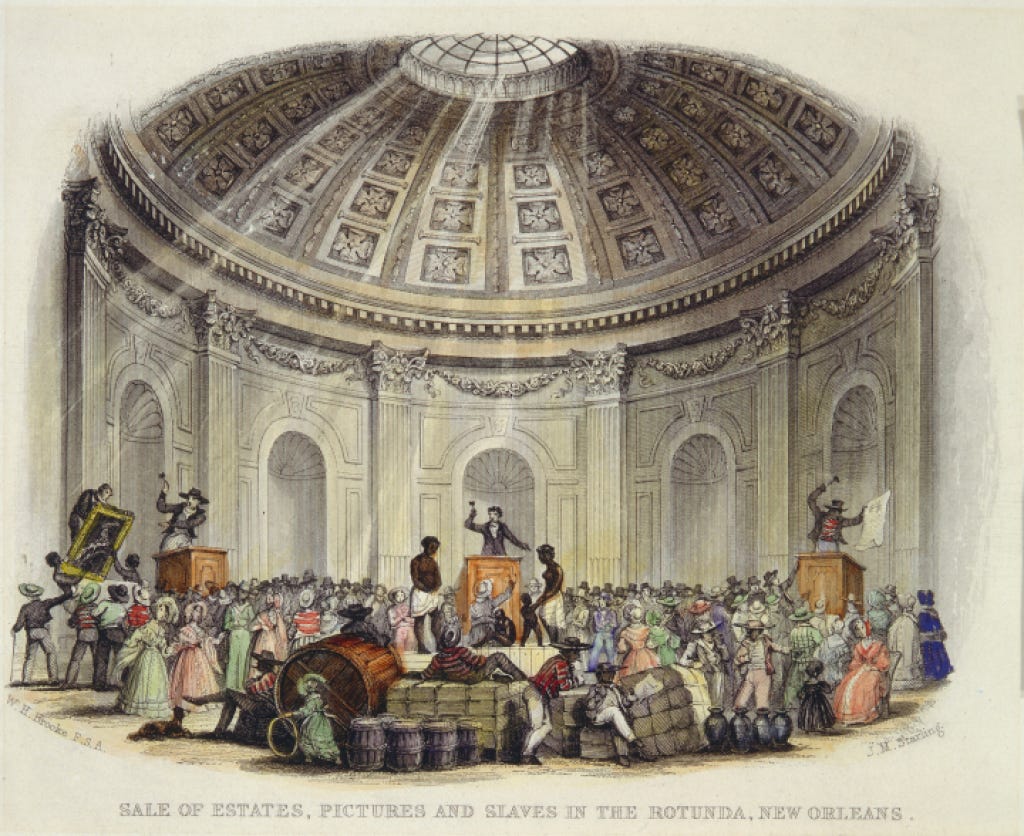
There are two views of this time that haunt me.
The first is what the birds saw.
The bald eagle, the kestrel, the hawk, the falcon. Black lines winding their way along the grassy paths, the beaten roads. Black knots collecting in pockets at crossroads, on mountain ledges, on riverbanks. Black men, fingers raw, holding tight to “a chain fastened at one end to the centre of the bar of a pair of hand cuffs, which are fastened to the right wrist of one, and the left wrist of another slave.”1 Black women, suckling infants they would never see grow old. Black girls on the cusp of menses, Black boys on the brink of big voices. Black adolescence eager to grow in land made supple by the blood and tears of their mothers, grandmothers, and great-grandmothers (some back to 1619), but that would never happen.
Taken from Virginia, Maryland, Delaware, the eastern seaboard, they would never see their homeland again.
Take me back to Old Virginny. Black feet stamping blood, sweat, and broken blisters into the dirt of broken promises and bitter dreams.
The Second Middle Passage.
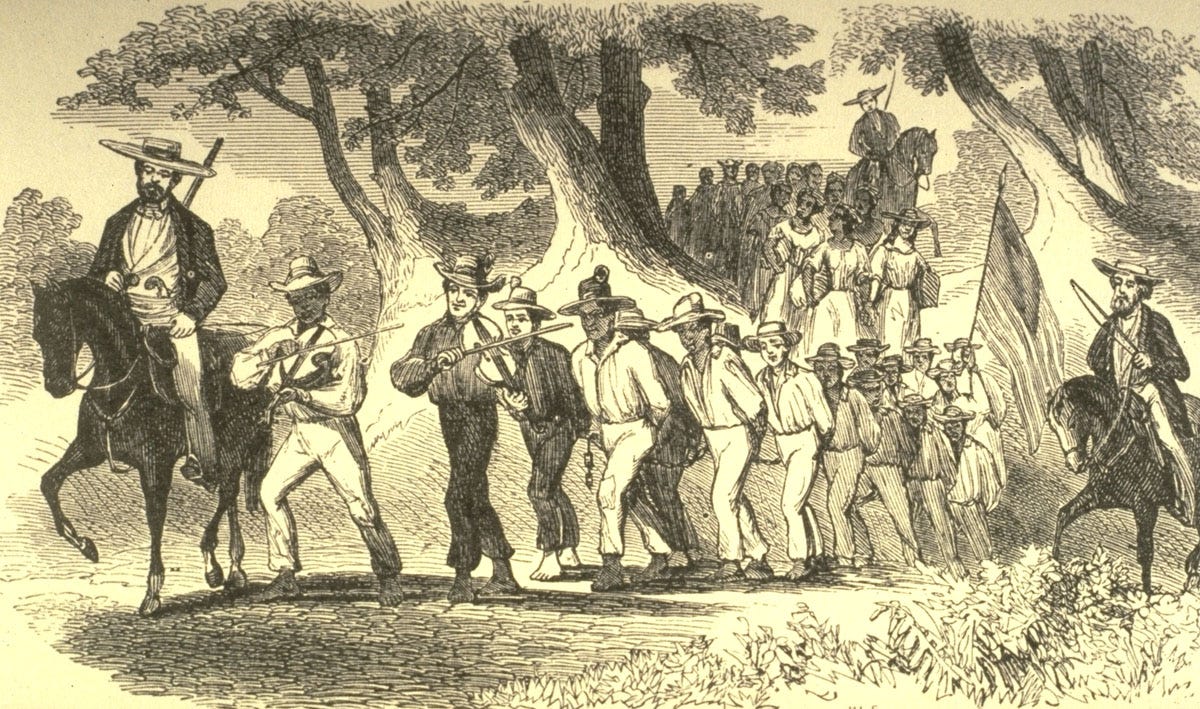
Between 1810 and 1820, about 120,000 enslaved women, children and men were sold or taken by their owners down South. Georgia, Tennessee, Alabama, Louisiana. White settlers carved these newest territories and states of U.S. empire from the flesh of the continent, flooding into land Thomas Jefferson purchased from Napoleon on the eve of the Haitian people’s declaration of independence.
Land that little French man never had a right to sell, much less give away, seeing as it wasn’t his.
And so, at first, the Americans “going west” did so illegally. But the federal government backed their defiant maneuvering. Federal agents engaged in political subterfuge familiar to conquistador-settlers since the 1620s. In the end, they engaged in and instigated war between Mvskoke bands of the Creek nation, siding against the Red Sticks (Upper Creek/Mvskoke) in a war waged by upstart military brats, one of whom was named Andrew Jackson.
By 1830, Jackson, now President, had signed the Indian Removal Act into law and then the bald eagle, the kestrel, the hawk, the falcon watched as new lines snaked across the grasslands, as new bodies fell to starvation, stress, and disease, as nation after nation walked at gunpoint from their homeland to a foreign land called Oklahoma.
The scale boggles the mind. Between 1820 and 1830, almost 300,000 Black women, children and men followed their cousins down, down, down southern roads to the delta. They walked on land, two, ten, fifty, two hundred at a time. “About five years ago, I remember to have passed, in a single day, four droves of slaves for the south west; the largest drove had 350 slaves in it, and the smallest upwards of 200. I counted 68 or 70 in a single coffle.“2
They rode on ships, over sea, along the Atlantic seaboard and around Florida before landing in New Orleans, the busiest slave market of all. They rode the rivers, skirting the Mason-Dixon line in steamboats on the Ohio River before reaching the mighty Mississippi and riding flatboats down. When men began laying iron planks down for railroads in South Carolina, Black people road those too.
At night, they waited at depots, taverns, and pens, watched over by white men eager to make themselves rich from a pound of Black flesh. “In the 1820s, Basil Hall, a British traveler, was told that during certain seasons of the year, “all the roads, steamboats, and packets, are crowded with troops of negroes on their way to the great slave markets of the South.””3
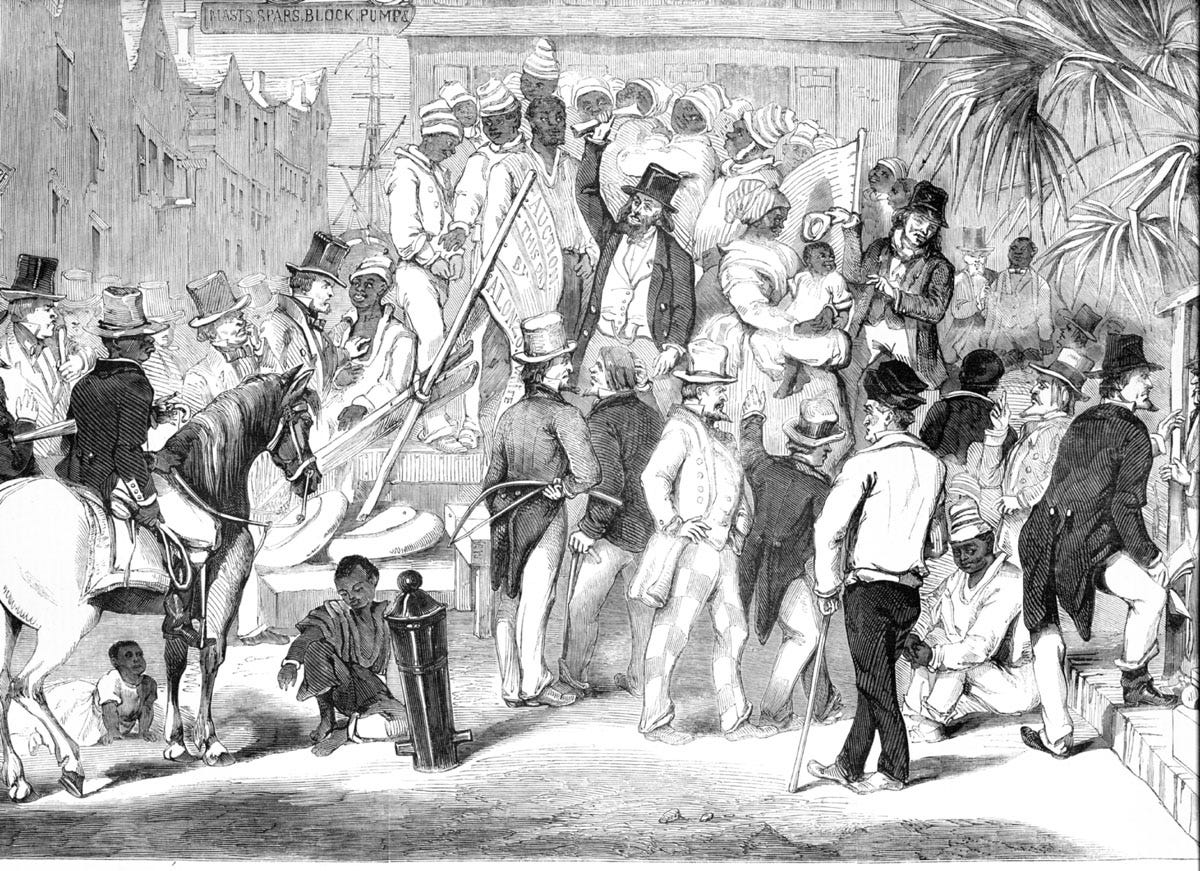
All told “...about two million slaves (men, women, and children) were sold in local, interstate, and interregional markets between 1820 and 1860, and that of this number perhaps as many as 260,000 were married men and women and another 186,000 were children under the age of thirteen.”4
And:
“If we assume that slave sales did not occur on Sundays and holidays and that such selling went on for ten hours on working days, a slave was sold on average every 3.6 minutes between 1820 and 1860.”5
And if we remember that slave ships took only about 500,000 Africans direct from the African continent to what would become the United States (compared to about five million who were taken to Brazil), the number two million moved in a domestic slave trade takes on a different meaning.

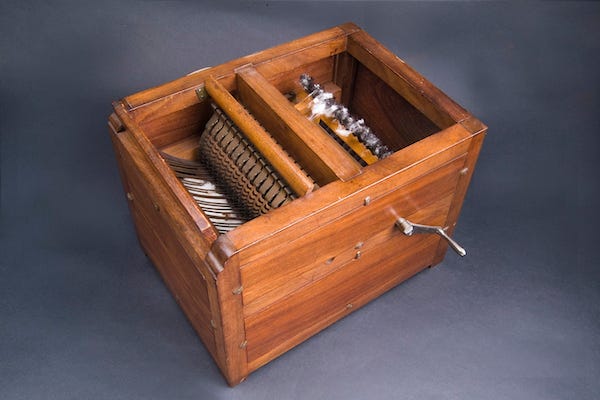
Two million souls. Land to fill, cotton to gin, thanks to a man named Eli and a contraption that looked like nothing more than a box with a metal gear and metal teeth, but that box became a set of jaws that ATE Black lives.
Two million souls. Mostly children, bid em in, bid em in, bid em in.
The Second Middle Passage. A curse that could never be undone. “Like some great, inescapable incubus, the colossal transfer cast a shadow over all aspects of black life, leaving no part unaffected.”6 The free black woman, the Black and Indigenous man, the child born in a fancy trade house in Charleston, the enslaved grandmother dreaming freedom into the next generation.
The slave trade touched everyone. It galvanized Vesey. It terrified Walker. It chastened Allen. It summoned visions from Nat. It tore Isabella from her son. It forced Harriet out of her garret to Philadelphia.
No one could escape the shadow of the trade.
The second view that haunts me is what the ants saw, the rooster, the palomino, the water moccasin.
The ones who watched the woman who tried, she tried to quiet the child. Who shook when the slave trader “stepped up to her, and told her to give the child to him.” Who “tremblingly obeyed.” The trader who “took the child by one arm, as you would a cat by the leg, walked into the house, and said to the lady, “Madam, I will make you a present of this little nigger; it keeps such a noise that I can’t bear it.”
The ones who heard the white woman say: “Thank you, sir.”7
The wails of the mother.
The horse that brought the Maryland man who survived his coffle from Selma to a new plantation in Alabama. The man who could not restrain himself from responding when the whip came down. Had he been free too long in that Catholic state up north? Had he been treated too well? Did it matter? Negroes don’t talk back in Alabama. When “the man raised his hoe in a threatening manner” the overseer fired. The man didn’t go down easy. “The wounded wretch raised himself once more, drew a knife from the waistband of his pantaloons, and, catching hold of the overseer’s coat, raised himself high enough to inflict a fatal wound upon the latter. Both fell together, and died immediately after.”8
The ant that watched the elderly white woman who traveled with one coffle through Georgia, for company, for safety. A woman’s virtue, after all, is all she has in the South.
That watched the Black girl who traveled with the old woman, as Black girls often did, forced to fetch food and water, forced to dress the aging body, forced to tend the horses, forced to listen to her mistress muse about better days.
The ants eyed the trader who did not dare disrespect the old woman, but, the first chance he could, “forced [the girl] to get up in the waggon with Finney, who brutally ill-used her, and permitted his companions to treat her in the same manner.” The gang rape that “continued for several days.” The fire ants spread word underground of the sale that followed once they arrived in Augusta.9
Like the fire ant, the women in the coffle watched. They had been forced to witness the violence, had witnessed with the girl, knew her violation, knew it and remembered or portended their own. These women talked about the crime on their kinswoman among each other, they “talked about this very much” and, in the talking, “many of them cried, and said it was a great shame.”10 The ant walked on, but didn't forget. (Ants don't, after all. Their memories scale across generations)
This offering is for the sliding scale of violence the human mind cannot accept or imagine, but can feel, can acknowledge, can memorialize. We don’t remember the Second Middle Passage, at least not well. Not in our histories, not in our stories, not in our minds, not in our solidarities.
How could we? When it means sliding from the scale of memories the size of rivers crawling the countryside, violence the weight of mountains? When it means witnessing a Black girl turned inside out and sold on a whim for fraternal sport? When the scale is dizzying, the destruction is leveling, and the mourning on-going?
This offering is belated, but beloved, a ghost and a crisis. It is for the parts of us that lie awake at night searching for lost kin, the parts of our souls seeking ancestors drowned in oceans with chains around their necks or running—always running—from the madness a cash crop made of men.
This offering asks our hearts, our minds, our hands to expand to take it all in and keep them, hold them: the memories, the people, the places, the times. Because they know, and we know, that the only way through the dark of each night—this centuries long night—is together.
The scale is the illusion. We are the baby’s cries and the knife and the witness and the mountain and the crowd of people thick with musk.
We are the shadow of a missing daughter or a lost son.
We are the ones looking up at the hawk, on the hunt for freedom.
We are the fire ant biting down on enslavers’ limbs.
We are the ones refusing to make our memories smaller than, less than.
We are a geological and genealogical menace. Our cause is righteous, our call is just.
No readings today; the footnotes are enough.
Theodore D. Weld, American Slavery as It Is: Testimony of a Thousand Witnesses (American Anti-Slavery Society, 1839).
ibid.
Steven Deyle, Carry Me Back: The Domestic Slave Trade in American Life (Oxford University Press, 2006).
Herbert George Gutman, Slavery and the Numbers Game: A Critique of Time on the Cross (University of Illinois Press, 2003).
ibid.
Ira Berlin, Generations of Captivity: A History of African-American Slaves (Harvard University Press, 2004).
This is in William Wells Brown's narrative.
James Williams, Narrative of James Williams: An American Slave, Who Was for Several Years a Driver on a Cotton Plantation in Alabama (Isaac Knapp, 1838).
Brown, Slave Life in Georgia: A Narrative of the Life, Sufferings and Escape of John Brown, a Fugitive Slave, Now in England (n.a., 1855).
ibid.
this is sacred work—the writing, the remembering, the invitation, the gathering across lives
whewww 😮💨