
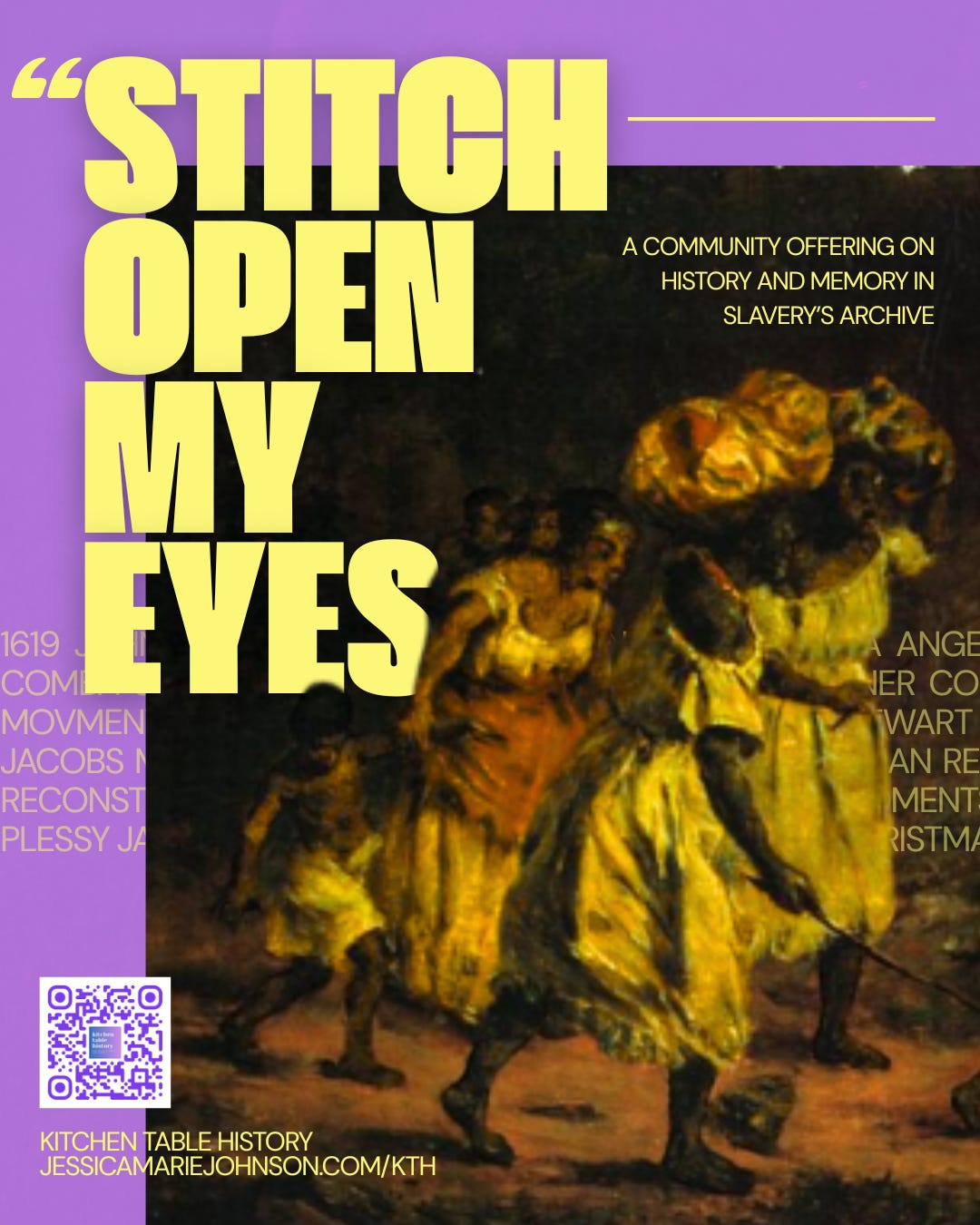
"Stitch Open My Eyes" A Community Offering
Coming Soon: “Stitch Open My Eyes” A Community Offering on History and Memory in Slavery’s Archive

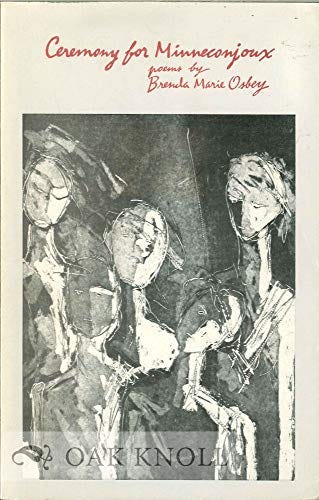
Reading New Orleans poet and Black woman literary genius Brenda Marie Osbey, I can feel the ritual, the mystery of a world unspoken and tender, the dark power of the Black feminine, the audacity of Black girlhood across time and space.
I turned to her poetry as I struggled to find words to describe this season’s community offering. On the one hand, there’s the documentary record, the methodologies attributed to professional historians, and the dry objectivity of the academic. On the other hand, there are the names in the family Bible, the hands held together in prayer and grace, the fingers pressing knives into cutting boards, the lips loosened with good food and good drank. The “Did You Know” that comes out of nowhere and unfolds reams of history stretching back through states, borders, islands, and oceans.
How these two sides of “doing history” come together could be tagged “African American History 101” is obvious.
But doing our history (Black history) has a gravitas to it, a deeper charge, a headier weight than a classroom can hold. If you’re a professional historian, you know what I mean. How often have you described your journey and started at the foot of an elder or with a playground experience? If you’re a family or professional storyteller, you also know what it means to be griot, translator, or master/mistress/mixter of ceremonies at the family function. Funerals and holidays hate to see you coming because you will hold court all night and don’t let anyone try to get a word in!
Boundaries and rubrics fail in the face of Black narrative and archival brilliance, which is, simply put, our ability to stitch ourselves into Black being despite and in the face of weapons of war raised against us.
Enter Brenda Marie Osbey, literally “Writing the Words:”
“i will stitch open my eyes
i will stitch them to my fingers
and together
they will witness the history
and hand down the tale”
- Brenda Marie Osbey, from “Writing the Words,” in Ceremony for Minneconjoux (1983, published in Callaloo in 1981)
In “Writing the Words,” the poet-narrator is witness, reader, researcher, writer, and historian. They see the everyday labor of a woman named sally, the everyday dismissal of her by a man named mohab who “could never love her.” They see the everyday parts of their lives, from the dirt washed off turnips to the city pavements. And in just three short pages, the poet-narrator reminds us that to be witness is also to “hand down the tale” is also to see even when you don’t want to see, is also to study in the tradition of ancestors who gobbled text, document, letter, and page, “reading by candlelight” even “after the lights turn off.”
For me, this is what it means to do history at our kitchen tables--it is about the document and the story, the tale and the text. It is about doing history in the name of and for the sake of witnessing. It is stitching open our eyes even when we don’t want to see the truth, and then pouring that truth through our fingers onto the page because our charge is to “hand down the tale.” In handing down the tale, we trust there is or will be someone there to receive it, a runner to pass our baton to. In that sense, the Black historian is a witness midwifing Black futures.
Stitch Open My Eyes delves into how we do that, how we do what we do.
Meet me back here in two weeks.
Community offerings are free and available online for free for one calendar year, but supporting the work is always welcome!