
Survival is a Promise (Black Creative Worlds: Week Seven)
"I want to be. I don't want simply to exist, then perish in a brief burst of light one dark night unnoticed unappreciated by anyone..." Audre Lorde

Black Creative Worlds is a community offering of notes, readings, and curriculum from my convening of Black Creative Worlds (a bit.ly/JHUBlackWorld seminar) in Spring 2025. Newsletters come out on Mondays from now through April with material for free and paid subscribers under the paywall jump. The full schedule is here.
For more on the Black World, including past seminar schedules and an essay about the Black World Seminar by Dr. Nathan Connolly visit: bit.ly/JHUBlackWorld.
I am not sure time travel isn’t possible. In everything Alexis Pauline Gumbs writes, I find stardust, volcanic ash, and salt water, the stuff of cosmos. The stuff we come from and stuff we are going back to. Some scholars know how to tell a beautiful story. Some know how to research deeply and inhabit the lives of their subjects. And some know how to take a topic apart, distill it to its molecules and atoms so we can understand its constituent parts—so we have no excuse not to rise to the call of the work demanded of us to change the world. Most scholars can do one or the other of these well. Gumbs can do all three.
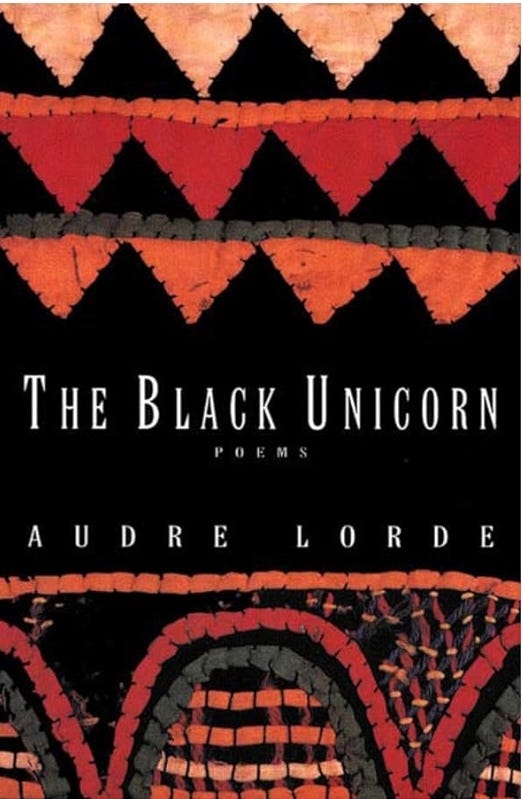
I first met Audre Lorde wandering used bookstores in Chicago. The book The Black Unicorn, seemed to jump into my hand. I felt that way about Octavia Butler too, and Elizabeth Alexander. As an adolescent, the books I needed leapt off the shelves and into my waiting arms. Later, I read This Bridge Called My Back, Fourth Edition: Writings By Radical Women of Color, as it circulated among radical womyn of color bloggers in the early aughts. Never before exposed to textual Black and Third World feminism, that volume knit together things I knew, things I feared, and things I needed to know to proceed in the world and not die. Lorde’s essay in that book (which was a talk given at a conference), “The Master’s Tools Will Never Dismantle the Master’s House,” forever changed how I understood what it meant to be in right relationship to institutions.
I offer this genealogy, but I am not sure why. Only that there is something about encountering Audre Lorde, whether on the page or in person, as I learned in Gumb’s biography, that asks you to seek out your origin story. I thought it was just her on the page, her words like a laser gutting me from the inside out. Apparently, Audre was just that kind of person in the world. A burst of light.
Questions, readings below; activities and a bit more under the wall.
What We Are Reading
Alexis Pauline Gumbs, Survival is a Promise: The Eternal Life of Audre Lorde
“Abolition is Adaptive and Intentional,” Andrea Ritchie, Practicing New Worlds: Abolition and Emergent Strategies (La Vergne: AK Press, 2023).
Discussion Questions
Who is Audre Lorde?
What does the structure of the book tell us about what Gumbs wants us to know about Audre Lorde? The length of the chapters, their order. The book itself is a physical representation of the life of Audre Lorde; what is the physical book doing?
Many of the chapters begin with a reference to something in nature. Sea. Ocean. Stars. Coal. What is Gumbs doing with nature, with the planet and the cosmos in relationship to Lorde?
Gumbs includes herself in the text as biographer and as shaper of the story. When does she do that? Why?
Some of the people in Lorde’s life (and ours) get their own attention, like Pat Parker and Gloria Joseph and Barbara Smith. Why do this in a book about Lorde?
Lorde’s immortal life is told mostly chronologically, but not entirely and not always. How is encountering her life in different phases and at different moments different in this text from more linear biographies? What do we get from the time travel?
What role does physical travel play in Lorde’s life? Sometimes she moves voluntarily, sometimes involuntarily, sometimes a combination of both. Is the immortal life of Lorde also a wandering life? What do we learn about what it means to be intentional and global from Lorde?
What was Lorde’s writing life? What were her writing practices? How did they change over the course of her life?
Both Lorde and Gumbs think deeply about the metaphysics of Black feminism. What do we learn about that in this book?
Lorde thinks a lot about her origin story, especially her family, her relationship with her father, her, mother. And Gumbs untangles, without destroyng Lorde’s mythography, a lot of the complicated dynamics. Who is the Audre embedded in a family structure?
Who is Lorde the mother? Not just biological, but also the mother of artists, poets, scholars?
Lorde seems to move from painful loneliness as a child (including a tragic first love) into a community forged from fire. The stakes for Black lesbians and Third World lesbians and feminists were deadly and high. What does intentional and adaptive (Ritchie) community look like for Lorde and for those around her?
Can we live Lorde’s eternal life? Is survival promised us?
Where are the “uses of the erotic” in Lorde’s life, at least as told by Gumbs. The sensual, erotic, delicious and tactile? Where can we spot those examples in our own lives?
Suggested Reading
Audre Lorde, “The Uses of the Erotic as Power,” Sister outsider: Essays and speeches (1984)
Audre Lorde, The Black Unicorn: Poems, (NY: W. W. Norton & Company, 1995).
Cherríe Moraga and Gloria Anzaldúa, This Bridge Called My Back, Fourth Edition: Writings By Radical Women of Color (Watertown, MA: Persephone Press, 1981).
Moya Z. Bailey, “All the Digital Humanists Are White, All the Nerds Are Men, But Some of Us Are Brave,” Journal of Digital Humanities (2012):
Barbara Smith, Patricia Bell-Scott, and Akasha (Gloria) T. Hull, eds., But Some of Us Are Brave: Black Women’s Studies., First Edition (New York, NY: Feminist Press at the City University of New York, 1982).
Rosalyn Terborg-Penn and Andrea Benton Rushing, Women in Africa and the African Diaspora: A Reader (Washington, DC: Howard University Press, 1987).
Courtney Thorsson, The Sisterhood: How a Network of Black Women Writers Changed American Culture (New York: Columbia University Press, 2023).
Robin Boylorn, “How to Not Die: Some Survival Tips for Black Women Who Are Asked to Do Too Much,” The Crunk Feminist Collective (2013), http://www.crunkfeministcollective.com/2013/06/07/how-to-not-die-some-survival-tips-for-black-women-who-are-asked-to-do-too-much
Brittney Cooper, Eloquent Rage: A Black Feminist Discovers Her Superpower (New York: St. Martin’s Press, 2018).
Alexis Pauline Gumbs, “Coal: Black Matter Oracle,” The Black Scholar 47, no. 3 (2017): 3–7.
Alexis Pauline Gumbs, “We Can Learn to Mother Ourselves:” a Dialogically Produced Audience an Black Feminist Publishing 1979 to the “present”,” Gender Forum: An Internet Journal for Gender Studies 22(2008):
Moya Bailey and Alexis Pauline Gumbs, “We Are the Ones We’Ve Been Waiting for,” Ms. Magazine Winter(2010): 41–42.