
Updated Provocations on Generative AI Paper Available for Download
A revised version of our preprint is now up!

In preparation for conference season, we have revised and updated our essay “Provocations from the Humanities for Generative AI Research” and it is now available for download on arXiv.
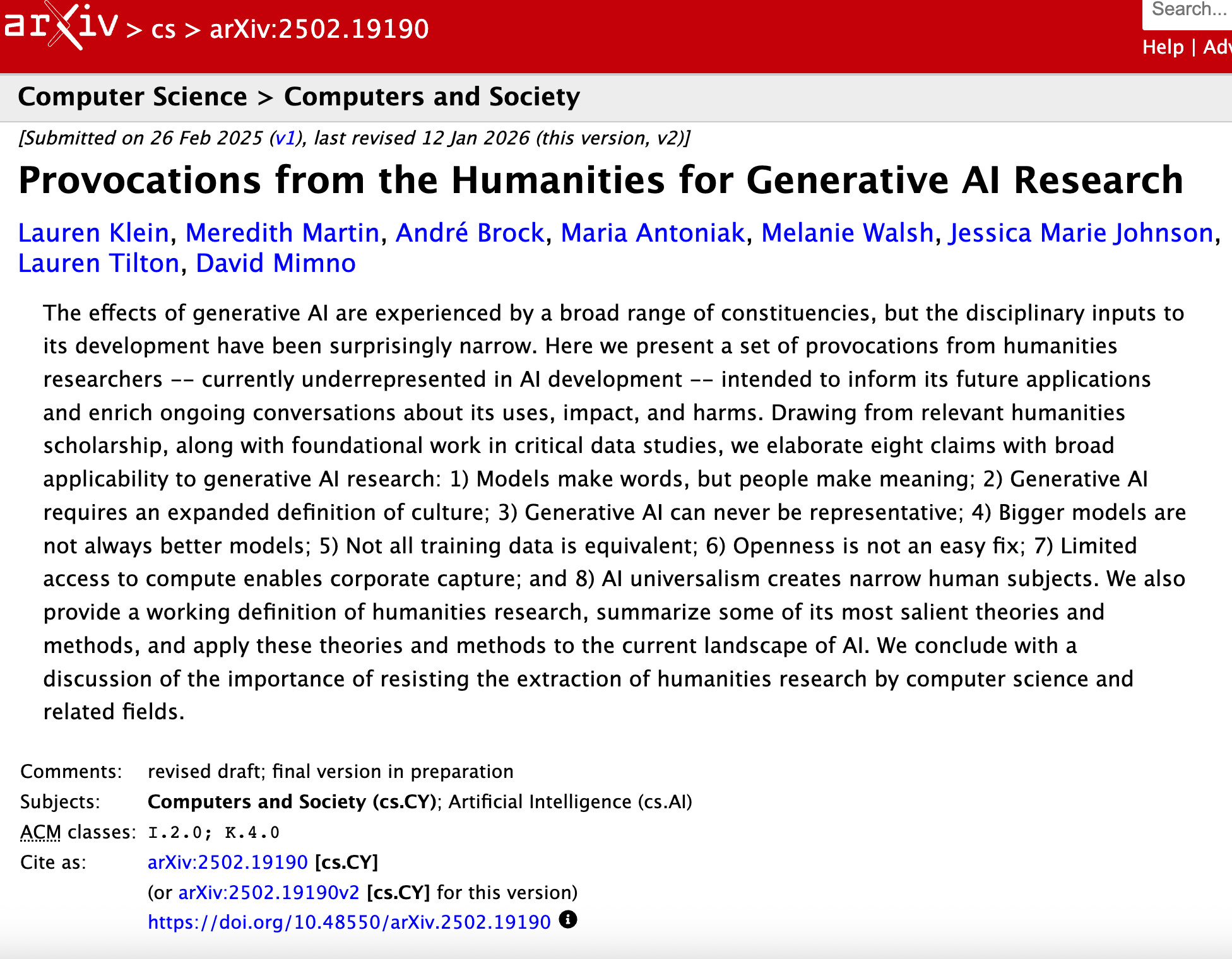
Lauren Klein, Meredith Martin, André Brock, Maria Antoniak, Melanie Walsh, Jessica Marie Johnson, Lauren Tilton, David Mimno, “Provocations from the Humanities for Generative AI Research,” arXiv:2502.19190, preprint, arXiv, January 12, 2026, https://doi.org/10.48550/arXiv.2502.19190.
The update includes action steps for researchers engaged in generative Ai who want to respond to or take up these provocations, as well as updating the provocations themselves to the current moment of corporate and/or university-sponsored Ai.
These provocations still only scratch the surface. Each one deserves its own shelf of books in the library. But a provocation has to start somewhere.
Abstract:
The effects of generative AI are experienced by a broad range of constituencies, but the disciplinary inputs to its development have been surprisingly narrow. Here we present a set of provocations from humanities researchers -- currently underrepresented in AI development -- intended to inform its future applications and enrich ongoing conversations about its uses, impact, and harms. Drawing from relevant humanities scholarship, along with foundational work in critical data studies, we elaborate eight claims with broad applicability to generative AI research: 1) Models make words, but people make meaning; 2) Generative AI requires an expanded definition of culture; 3) Generative AI can never be representative; 4) Bigger models are not always better models; 5) Not all training data is equivalent; 6) Openness is not an easy fix; 7) Limited access to compute enables corporate capture; and 8) AI universalism creates narrow human subjects. We also provide a working definition of humanities research, summarize some of its most salient theories and methods, and apply these theories and methods to the current landscape of AI. We conclude with a discussion of the importance of resisting the extraction of humanities research by computer science and related fields.
The header image is from Tahir Hemphill’s series “Maximum Distance, Minimal Displacement.” Tahir is the founder of the Rap Research Lab. Check out their work below:
I'm teaching this in my Current Trends and Issues in Publishing course this semester! Thank you!