

In 1619, a Portuguese slaver named Sao Joao Bautista left the Portuguese-controlled port of Luanda in the colony of Angola, on the coast of West Central Africa. The Portuguese infiltrated the Kingdom of Kongo and established, by military might and political machinations, a fortified port town at Luanda in 1575.1 The Portuguese came for gold, then slaves, pushing West Central Africans into the Middle Passage and landing them on sugar plantations in Brazil. By 1595, the Portuguese held the Spanish asiento, a contract European merchants craved more than Ai data centers crave fresh water. The asiento granted merchants the privilege of trading and selling African captives to and in land claimed by the Spanish empire. Luanda became ground zero for this Black gold.
1595 is still years away from 1619, so why does this matter? First, the Portuguese had been trading, engaged in diplomacy, and engaged in warfare and slave raiding in West Central Africa for over a century by the time the Sao Joao Bautista left port. Over a hundred years for kings and elites, traders and peasants, foreigners and locals to create social ties, kinship networks, livelihoods, and spiritual paths centered on profiting from or defending themselves from slaving. A new Atlantic world, as some scholars have argued.
Second, the two sides of 1619 give me a glimpse into the way even conquistador-settlers, with all their pretentions and hubris, couldn’t control the history they themselves set in motion.
I describe the Portuguese in Africa as conquistador-settlers, and I thank Tiffany Lethabo King for her framing of “conquistador-settler” (which is in a footnote in The Black Shoals):
“”I argue that “settler” does not explicitly name its relationship to the ongoing violence of genocide that continues to be enacted on Indigenous bodies. The term “settler” also entirely disavows the relationship that White settlers have to the institution of slavery, its afterlife, and ongoing practices and regimes of anti-Black violence. “Conquistador-settler” invokes both the violence enacted on the Indigenous and Black body and the possession of land.”2
As conquistador-settlers, the Portuguese did not arrive in good faith, never mind their efforts at diplomacy and their recognition that, as Herman Bennett argues in African Kings and Black Slaves, the Kings of Kongo and Ndongo were sovereigns in their own right.3 If, as Aurelia Martín Casares argues in their chapter in Transatlantic Bondage: Slavery and Freedom in Spain, Santo Domingo, and Puerto Rico (edited by the brilliant Lissette Acosta Corniel), “the enslavement of Black Africans was in fact a commercially driven form of enslavement, as opposed to a war-motivated one,” then I can only conclude that Iberian relations with the continent were stained with a touch of the tarbrush.4 Especially after 1441, the year the first slave ship left the African continent flying a European flag and arrived in Lisbon.
Which is to say, the Portuguese came to Kongo, Angola, and then Ndongo to extract and they extracted on devastating terms. Even missionaries, who wanted souls at least as much as they wanted profit, could only imagine claiming souls through destruction of personhood. As Linda Heywood explains in Njinga of Angola: Africa’s Warrior Queen:
“In 1582, Father Barreira interviewed a very old, important religious official who was the spiritual authority in a province allied with the Portuguese. This official was believed to have the power to control the weather, ensure the health of the population, and provide other important services. Barreira was alarmed at the nganga’s appearance, noting that he was apparently living as a woman, at least outwardly--his hair was long and flowing, and he was dressed in a long robe “made from his hair” that was wrapped with many layers of cloth (panos) normally worn only by women. When Barreira confronted the nganga, he revealed that he had been born a man but the “demon” had told his mother that he would die immediately unless he “became a woman.” Barreira publicly shamed the local nganga by cutting off [her] hair and taking away [her] “superstitious” religious paraphernalia. He went even further, planting a cross where the nganga had been operating and immediately setting to work to build a church on the very spot where the nganga’s shrine had stood.”5
This is what it means to be a conquistador-settler: negotiate in bad faith, reject what you haven’t the grace to understand, and when you don’t get what you want, scorch the earth and blame your victims for your crimes.
In the end, the conquistador-settler cannot create. They can only destroy.
By 1617, the Portuguese had solidified their hold on the economies and politics of Kongo and set their sights on moving beyond Angola to subduing Ndongo to Portuguese rule. For three years, roughly 1617 through 1620, led by the newly arrived governor Luis Mendes de Vasconçelos and his son João, the Portuguese waged war on Ndongo. They mobilized their allies in Kongo and Angola. They mobilized and allied with the Imbangala, a ferocious group described by John Thornton as not quite an ethnicity, not quite a nation or kingdom, more of “a company, or several independent companies, of soldiers and raiders who lived entirely by pillage.”6 And they laid waste to cities, villages, and farmland.
Between 1618 and 1620, over fifty thousand Africans would be exported from Luanda alone. By 1621, Mendes de Vasconçelos, father and son, extracted a peace treaty from Ndongo that shredded the kingdom of its former sovereignty and committed them to the same slave trade they’d become victims of:
“In four years of fighting, Luis Mendes de Vasconçelos had brought a total of 190 sobas directly under Portuguese control. More than half of these men—109, to be precise—were subjugated during the campaigns led by Mendes de Vasconçelos’s sons, and each of them was required to pay four slaves to the Portuguese king.69 In addition, the governor imposed a tribute of one hundred slaves annually on Ngola Mbande and ordered the provincial lords and their kijikos to pay tribute and taxes as well.”
Then father and son left Angola and returned to Europe, never having to take stock of what they unleashed.
And what did they unleash?
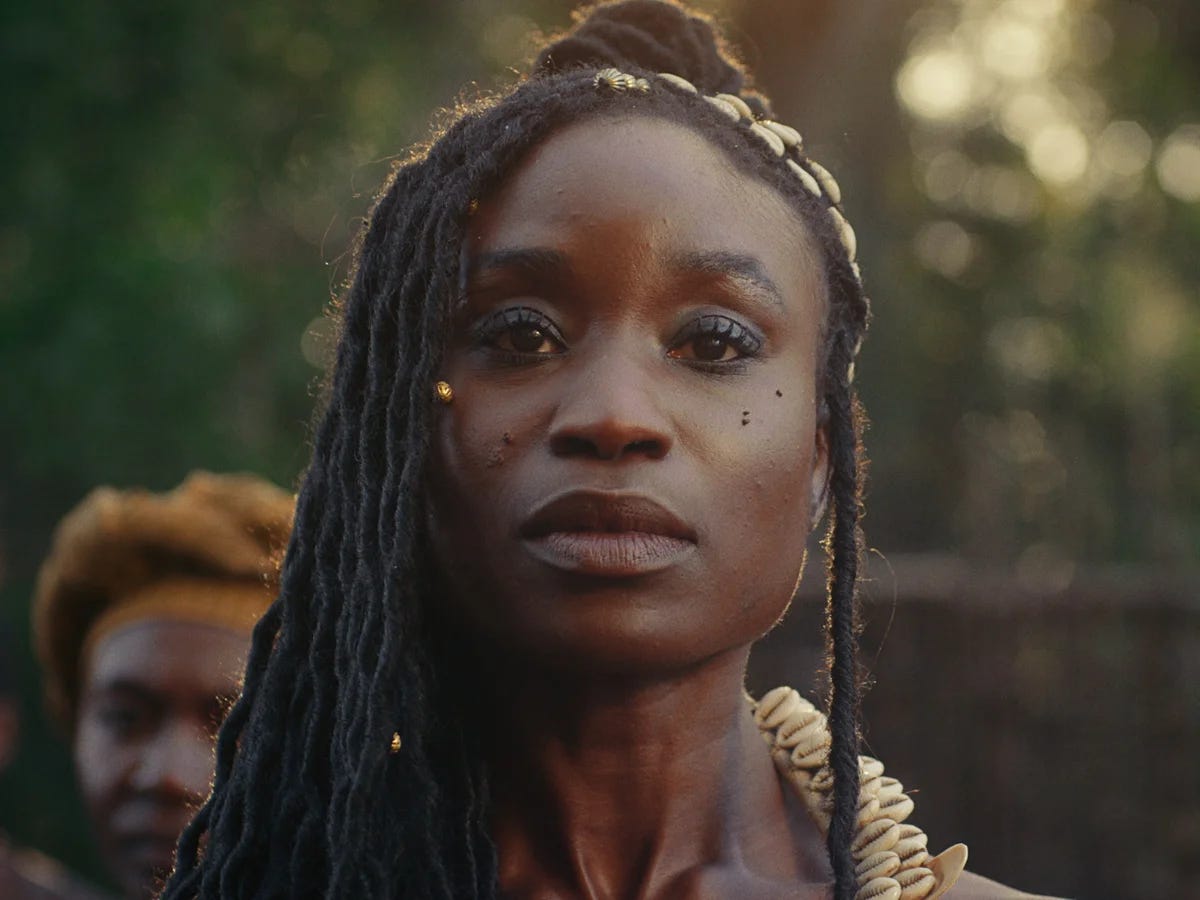
I wonder if it is right or wrong to say the ones who hate us feel anger towards us. I wonder if the energy needed to marshal genocidal extraction and call it “just war” or business as usual or empire, I wonder if we understand those forces enough to name them. I wonder if naming it anger does the job.
The men who killed Renee Good, Alex Pretti, Keith Porter, and who kill and rape so many others...are they angry?
I don’t wonder if Mendes de Vasconcelos, father and son, felt anger. But sometimes I test my mettle as a historian and try to imagine, try to confront, try to settle into the grotesque, the abnormal, the sociopathic, the shredded human collage of bones and blood that is white mastery, European conquest and American empire.
Anger is a strange emotion. In this modern era, Black women aren’t supposed to be angry. But then again, we aren’t supposed to be anything. Black femme affect that transgresses is basically Black femme affect that exists--delicious, audacious, deliberate, and ratchet.
In the midst of trying to keep his kingdom, Ngola Mbande, did many terrible things. He murdered his sister’s son to keep him from succeeding the throne. He sterilized her and his sisters, to prevent any further challenges. Just men being men, yes? Or maybe the force of a curse unleashed?
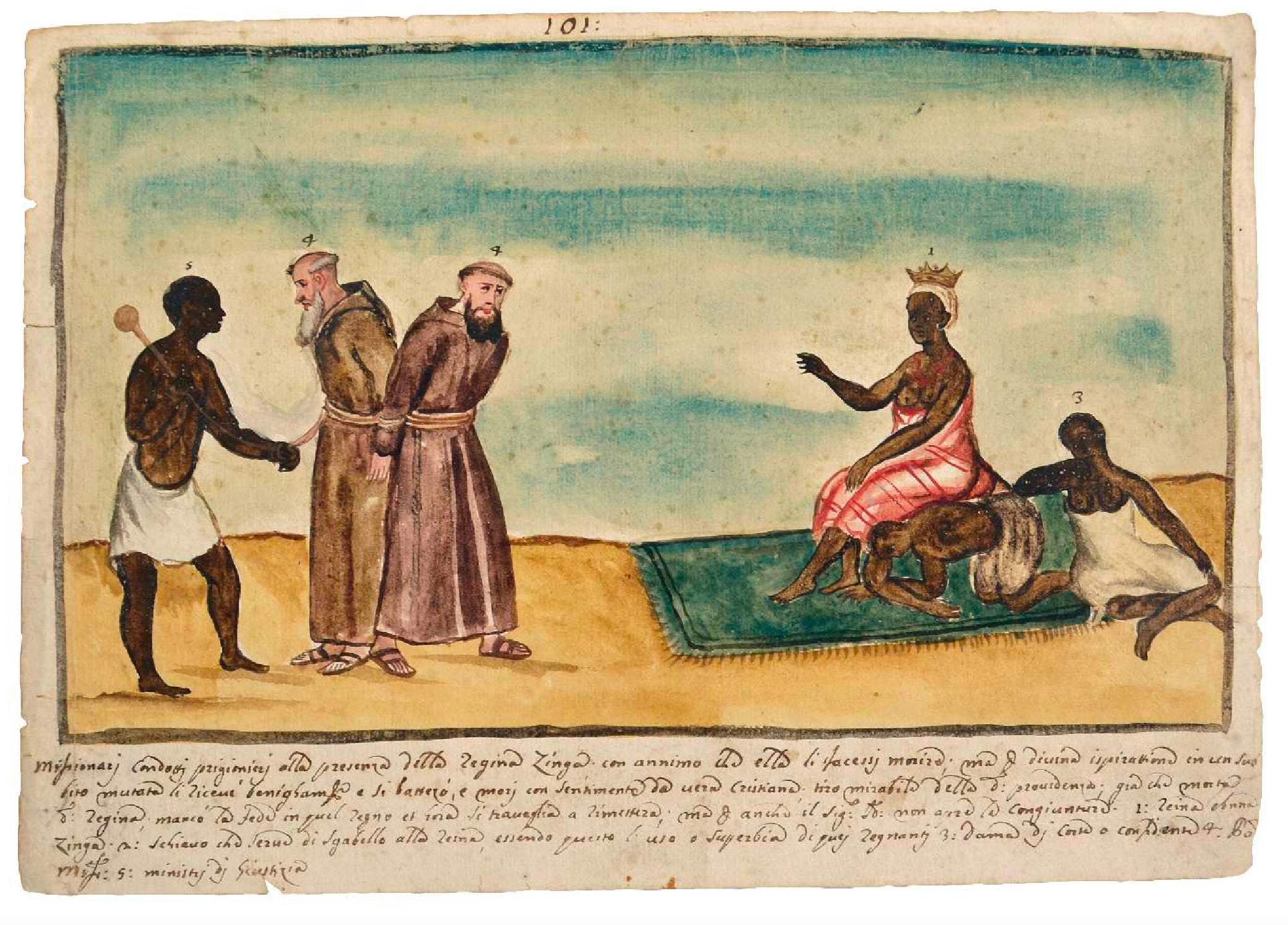
Anger is a wonder. One of his sisters was named Njinga. Within three years, Njinga had maneuvered herself into leadership, claimed the throne, rejected the Portuguese’s demands for slaves, and launched a military and political career that would bring her down to us in history as the Warrior Queen of Ndongo and Matemba.
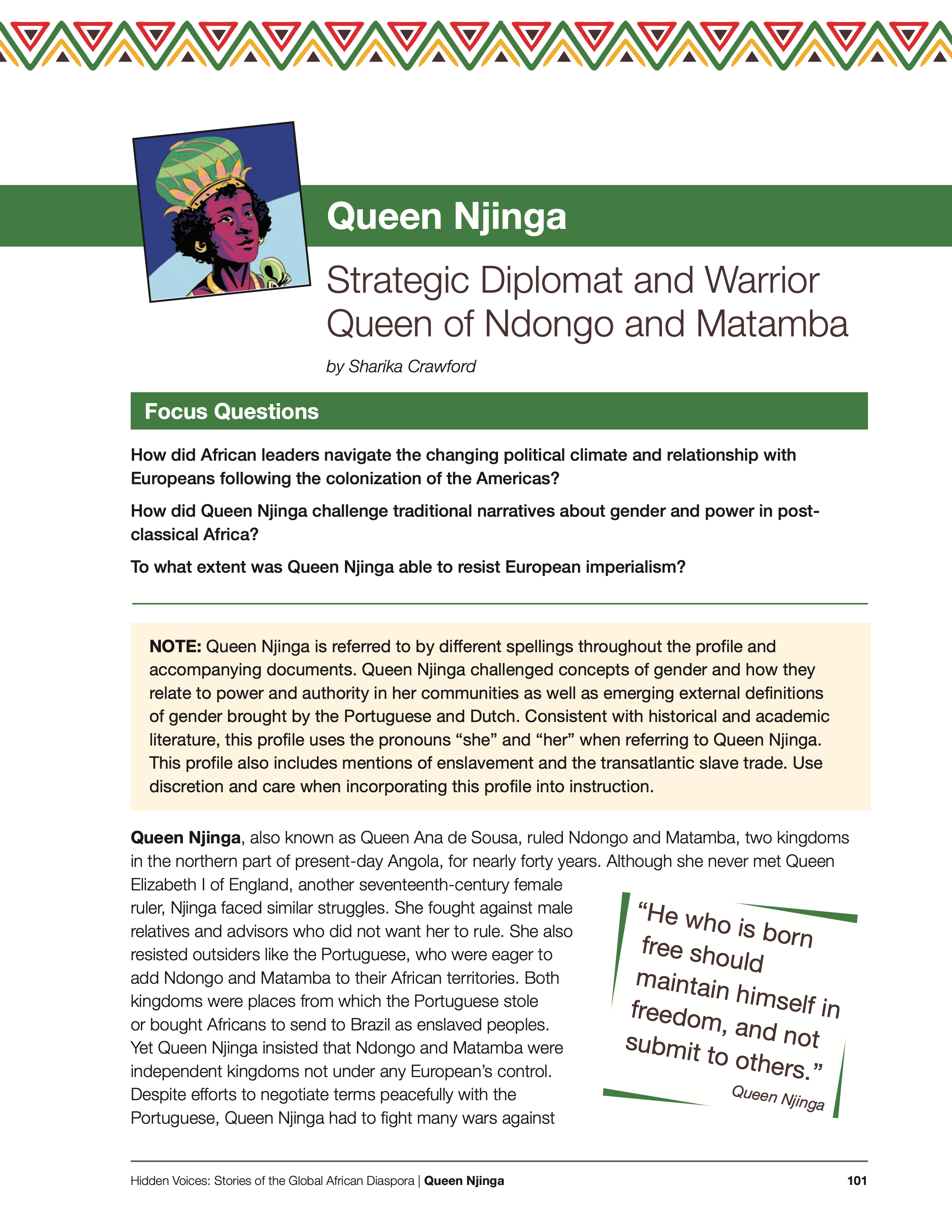
Njinga’s reign is too much for this offering, but in the reads below there is a profile written about her for the City of New York’s Hidden Voices of the Global African Diaspora curriculum. It is worth reading, sharing, using, teaching. Perhaps alongside Audre Lorde’s “Uses of Anger” or bell hooks’s Killing Rage or Kellie Carter Jackson’s award-winning We Refuce: A Forceful History of Black Resistance (a book I can’t seem to stop talking about).
Instead of Njinga’s rule, I wanted to use this offering to sit with 1619 and connect with Njinga on the brink, a woman who knew the worst that a woman can know. Who saw her land occupied by a capricious foreign force, her family turning against itself and and each other in a struggle to survive, herself and her sisters violated, and more and more. We can always imagine the more.
I want to sit with and see 1619 from the other side. We know what it begot on the eastern side of the Atlantic ocean, 20 odd Negroes and all that. But the Portuguese also unfurled another force of nature in Njinga, the daughter and sister of a king, who Ngola Mbande sent to meet the new Portuguese governor in 1621 and negotiate with him on behalf of her brother and Ndongo.
This girl burned with a righteous and scared and aggrieved fury.
This girl, despite having been betrayed by her own brother, still stood before the Portuguese and dared to fight. And plotted her revolt.
The Njinga of 1621 was pissed and petty. She had seen the Imbangala almost wipe her people from the face of the Earth. She held a grudge and it sounded like the cries of her infant son.
Angry? God yes. Devastated? Of course. But she did not fold up and retreat. She used the power she had to take action. She showed up and demanded a new world be made from the spirits of children she could never have. And then she fought like hell to bring that world into being.
There are forces being unleashed around us, realities being unveiled, and the physical threat grows every day--more for some than others. It is hard to see straight. Sometimes it is hard to see or trust anything.
Njinga couldn’t see her way to 1624 or 1644 either (or maybe she could).
But what she could and did do is step into the power she had as unsettled as that power felt, as contradictory and complicated and even conspiratorial as that power was and set her mind on the next thing that needed to be done. She didn’t know if she’d win, but what choice did she have?
What choice do we have? We can concede nothing. We are being called to create the next world.
Reads
A Timeline of the Global African Diaspora (Hidden Voices)
Queen Njinga Profile (Hidden Voices)
West Central Africa Maps of the Slave Trade from David Eltis et al., Atlas of the Transatlantic Slave Trade (Yale University Press, 2010).
Excerpt from Jean Barbot, An Abstract of a Voyage to Congo River (1700) from David Eltis et al., Atlas of the Transatlantic Slave Trade (Yale University Press, 2010).
“Angela’s Exodus Out of Africa” Daina Ramey Berry and Kali Nicole Gross, A Black Women’s History of the United States (Beacon Press, 2020).
John K. Thornton, “Legitimacy and Political Power: Queen Njinga, 1624–1663,” The Journal of African History 32, no. 1 (1991): 25–40
bell hooks, Killing Rage: Ending Racism (Holt Paperbacks, 1996).
Kellie Carter Jackson, We Refuse: A Forceful History of Black Resistance (Basic Books, 2024).
Kali Gross, Vengeance Feminism: The Power of Black Women’s Fury in Lawless Times (Seal Press, 2024).
Nikki M. Taylor, Brooding over Bloody Revenge: Enslaved Women’s Lethal Resistance (Cambridge University Press, 2023).
Cécile Fromont, Images on a Mission in Early Modern Kongo and Angola (Penn State Press, 2022).
Resources
Map of the Slave Trade, 1500-1900 (Slave Voyages)
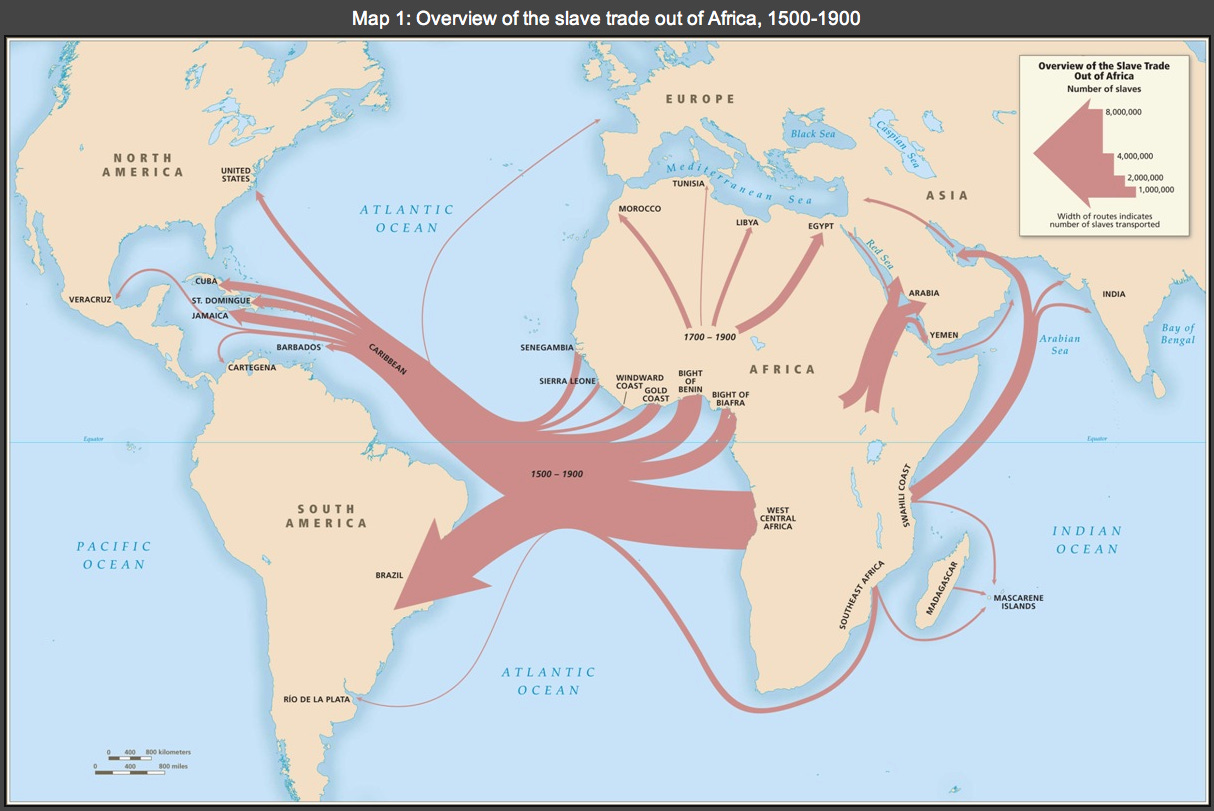
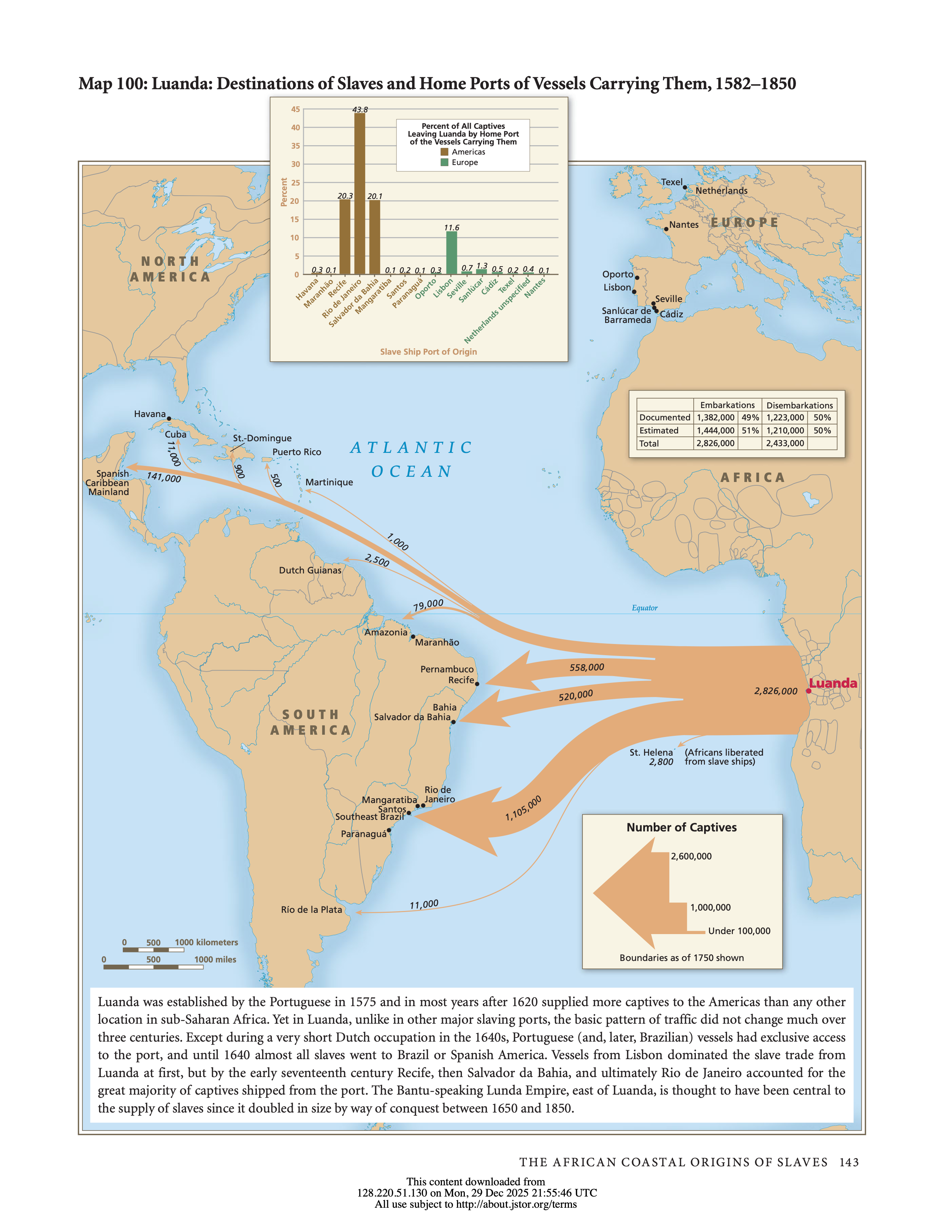
Luanda: Destinations of Slaves and Home Ports of Vessels Carrying Them, 1582-1850
This is offering #1 of Stitch Open My Eyes a 12-week community offering on history and memory in slavery’s archive. Because the Black freedom struggle during slavery should be a topic of conversation at every kitchen table. Follow along by subscribing below.
This post may contain affiliate links, meaning I get a commission if you decide to make a purchase through my links, at no cost to you.
This was over eighty five years into their time in the region. Portuguese and Kongo become diplomatic partners in 1491 when becomes the Mbanza Kongo (king of the Kingdom of Kongo) Nzinga-a-Nkuwu converts to Catholicism and becomes King Joao the I.
Tiffany Lethabo King, The Black Shoals: Offshore Formations of Black and Native Studies (Duke University Press Books, 2019).
Herman L. Bennett, African Kings and Black Slaves: Sovereignty and Dispossession in the Early Modern Atlantic (University of Pennsylvania Press, 2018).
Aurelia Martín Casares, “Spanish Slave Legislation: From Slavery to Abolition in Spain and the Americas,” in Transatlantic Bondage: Slavery and Freedom in Spain, Santo Domingo, and Puerto Rico, ed. Lissette Acosta Corniel (State University of New York Press, 2024).
Linda M. Heywood, Njinga of Angola: Africa’s Warrior Queen (Harvard University Press, 2017).
John Thornton, “The African Experience of the ‘20. and Odd Negroes’ Arriving in Virginia in 1619,” The William and Mary Quarterly 55, no. 3 (1998): 421–34, https://doi.org/10.2307/2674531.
Powerful, educational and truthful. Thank you for sharing with so many. It will have an impact.