
Fifth Offering: Discernment in a Land of Delusions
Elizabeth Freeman knew “something is not like slavery.” Only slavery is slavery.

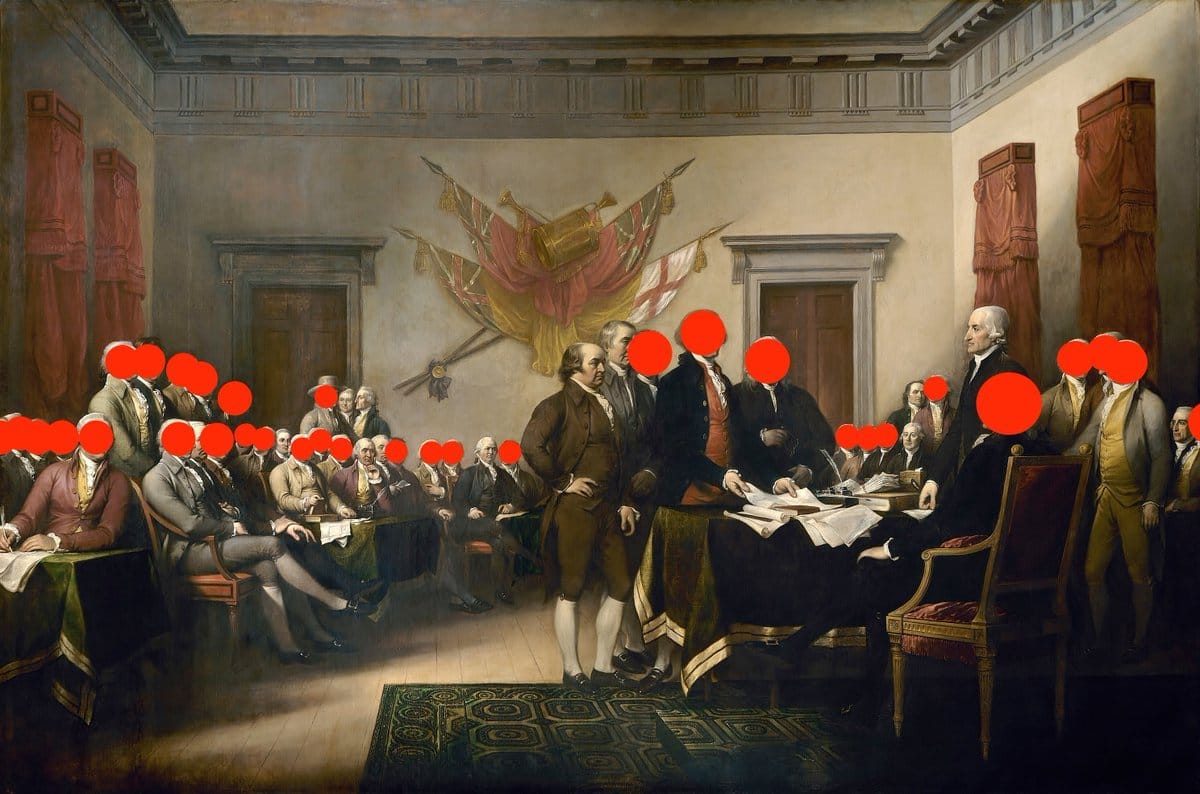
So that when the horns blew and the snare drums began their trrraa tat tat tat and that strange flag of many colors began to fly over the homes of the ones who were enslavers and the ones who were not, is it any wonder that delusion reigned?
Enslavers wanted slaves and power. They wanted three-fifths additional accounting. They turned the conundrum of a thing a that speaks, that lives, that breeds into a politics of representation. They wanted the army on call to put down slave insurrections. They’d learned, from the “ones who rebelled and resisted and rejected the burden of bondage in plain view” that attempting to turn a person into property required force of arms and military might. They wanted a slave trade that continued into the rising sun, winking at their colleagues that it would all end at some point, on its own, somehow. They wanted treaties they could break (with Indigenous nations) and purchases they could make (which they would, later, with France, buying some strange place called “Louisiana”). Slaves became power and power came with slavery.
Black people watched, wary, as compromise after compromise unfolded in Philadelphia. Are there words for the betrayal? All men are created equal. Women nowhere to be found (men of their time).
Elizabeth knew betrayal. Not from her owner, Hannah Ashley, the wife of John Ashley. “The notion of private/public assumes that the household is a family and thus private. This has made it difficult to see the household as a workplace and, beyond gender relations, as a field of power relations and political practices.”1 Elizabeth knew this. When Hannah raised a hot iron against her sister (possibly her daughter), Elizabeth blocked it with her arm and then wore the wound openly around the house. “Ask Mistress,” she answered, when guests asked about her injury.2
No, Elizabeth didn’t feel betrayed by Hannah. She had never been fooled by pretty words and did not need to “remember the ladies.”3 She’d almost lost an arm to one.
She didn’t feel betrayed by John Ashley either, her so-called master, who spent days in revolutionary struggle, arguing that to be a slave was the same as being in subjection to a tyrant—except this tyrant was the King of England. Elizabeth lived and worked in his home, provided food and service to meeting after meeting against empire, including, some say, one fateful one. In 1773, when “eleven of Sheffield’s wealthiest and most influential residents gathered” to draft the Sheffield Declaration, considered a precursor to the Declaration of Independence.4 “By some accounts, Freeman was in the very room where the documents were being drafted, serving the men as they dreamed of freedom.”5
“Something is not like slavery,” a wise historian once told me. “Slavery is like slavery.” Not taxation without representation, not forced quartering of soldiers, not lack of representation or disenfranchisement. Terrible occurrences, terrible politics to have to navigate around. But slavery is not a metaphor. Only slavery is slavery.
The enslavers who signed the Declaration of Independence and then carved out a slaveholding social safety net from the Constitution knew that. And so did Elizabeth.
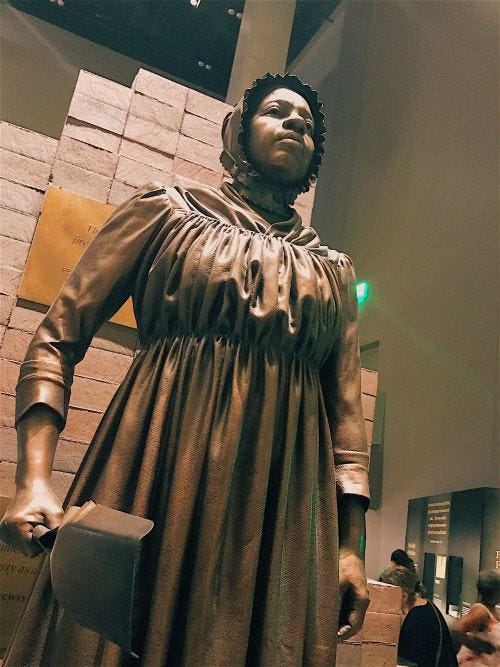
“Any time, any time while I was a slave, if one minute’s freedom had been offered to me, and I had been told I must die at the end of that minute, I would have taken it—just to stand one minute on God’s earth [sic] a free woman I would.”6
And since Elizabeth knew exactly what slavery was—because she lived it—and she knew exactly what her slaveowning owner had debated into the wee hours of the night—because she labored to make that night a possibility—she therefore knew a little something about the way enslavers lied to themselves about their own truths, failing to live up to even their partial promises (men of their time) or expectations.
It is said, that when the news spread that Massachusetts had a new constitution, declaring all men created equal, Elizabeth decided she would force those men to put some truth to what they said.
“Sir…I heard that paper read yesterday that says all men are born equal, and that every man has a right to freedom… I am not a dumb critter; won’t the law give me any freedom?”7
This week’s offering is for Elizabeth Freeman, in honor of her discernment, her ability to see through the delusions of revolution into the heart of the problem of revolutionary America, her determination to carve a meaningful freedom out of a new nation built on slavery. Her case made it to the county court. In 1781, the jury awarded Freeman her freedom and 30 shillings for “damages.”8 Ashley, a true Patriot, appealed the ruling. But then Quok Walker, who, since 1781, had been caught in a series of court cases against an enslaver who’d pursued him after he ran away, won his court case—and his went all the way to the Massachusetts Supreme Court.
In 1783, Chief Justice William Cushing offered his “instructions to the jury”:
“But whatever sentiments have formerly prevailed in this particular or slid in upon us by the example of others, a different idea has taken place with the people of America, more favorable to the natural rights of mankind, and to that natural, innate desire of Liberty, with which Heaven (without regard to color, complexion, or shape of noses--features) has inspired all the human race. And upon this ground our Constitution of Government, by which the people of this Commonwealth have solemnly bound themselves, sets out with declaring that all men are born free and equal--and that every subject is entitled to liberty, and to have it guarded by the laws, as well as life and property--and in short is totally repugnant to the idea of being born slaves. This being the case, I think the idea of slavery is inconsistent with our own conduct and Constitution; and there can be no such thing as perpetual servitude of a rational creature, unless his liberty is forfeited by some criminal conduct or given up by personal consent or contract “
Ashley dropped his appeal. And Elizabeth did stand, many minutes, on God’s Earth as a free woman. She celebrated her new status by becoming the namesake of freedom (”Elizabeth Freeman”) and moving out of that house of bondage. She found work as a governess, earning enough for herself to purchase a house and land for herself and her children. She died in 1829.
And Massachusetts became the third state to abolish slavery within its boundaries, the only state to do so by Supreme Court decision.
May our discernment lead us through the morass of discourse and disinformation. May we continue to fight for a material reality that centers our most radical and delicious freedom dreaming—not the “slave’s freedom” they think we should have.9
Readings
“Historical Painting Is Altered to Show Most Declaration of Independence Signatories Were Enslavers,” Hyperallergic, June 18, 2020, https://hyperallergic.com/historical-painting-is-altered-to-show-most-declaration-of-independence-signatories-were-enslavers/.
Jessica Marie Johnson, “Fourth Offering: In Plain Sight,” Kitchen Table History, February 1, 2025, https://www.kitchentablehistory.blog/p/fourth-offering-in-plain-sight.
Thavolia Glymph, Out of the House of Bondage: The Transformation of the Plantation Household Cambridge University Press, 2008).
“Massachusetts Constitution and the Abolition of Slavery | Mass.Gov,” accessed February 27, 2026, https://www.mass.gov/guides/massachusetts-constitution-and-the-abolition-of-slavery;
Gloria J. Browne-Marshall, “1619 to 1819: Tell Them We Fought Back, A Socio-Legal Perspective,” Phylon (1960-) 57, no. 1 (2020): 37–55;
Elaine MacEacheren, “Emancipation of Slavery in in Massachusetts: A Reexamination, 1770-1790,” The Journal of Negro History 55, no. 4 (1970): 289–306, https://doi.org/10.2307/2716174;
First Lady Abigail Adams "Remember the Ladies" Letter, C-SPAN, 2013, https://www.c-span.org/clip/c-span-specials/first-lady-abigail-adams-remember-the-ladies-letter/5153449;
Abigail Higgins, “How Elizabeth Freeman Sued for Her Freedom—and Won,” HISTORY, March 22, 2019, https://www.history.com/articles/elizabeth-freeman-slavery-case-dred-scott-freedom
“MHS Collections Online: ‘Mumbett’ (Manuscript Draft), by Catharine Maria Sedgwick, 1853,” accessed February 27, 2026, http://www.masshist.org/database/547;
“Elizabeth Freeman, Her Case for Freedom, and the Massachusetts Constitution | Constitution Center,” National Constitution Center – Constitutioncenter.Org, accessed February 27, 2026, https://constitutioncenter.org/blog/elizabeth-freeman-her-case-for-freedom-and-the-massachusetts-constitution;
NMAAHC, American History Through an African American Lens - Petitioning For Freedom: Elizabeth Freeman, Tumblr, n.d., accessed February 27, 2026, https://nmaahc.tumblr.com/post/163991306641/petitioning-for-freedom-elizabeth-freeman
“Africans in America/Part 2/Commonwealth v. Jennison,” accessed February 27, 2026, https://www.pbs.org/wgbh/aia/part2/2h38t.html.
This is offering #5 of Stitch Open My Eyes a 12-week community offering on history and memory in slavery’s archive. Because the Black freedom struggle during slavery should be a topic of conversation at every kitchen table. Follow along by subscribing below.
This post may contain affiliate links, meaning I get a commission if you decide to make a purchase through my links, at no cost to you.
Thavolia Glymph, Out of the House of Bondage: The Transformation of the Plantation Household Cambridge University Press, 2008).
Catherine Sedgwick unpublished mss describes the life of “Mum Bett” the name Elizabeth Freeman was forced to answer to before her freedom. https://www.masshist.org/database/viewer.php?item_id=547&mode=transcript&img_step=7#page7
First Lady Abigail Adams "Remember the Ladies" Letter, C-SPAN, 2013, https://www.c-span.org/clip/c-span-specials/first-lady-abigail-adams-remember-the-ladies-letter/5153449.
Abigail Higgins, “How Elizabeth Freeman Sued for Her Freedom—and Won,” HISTORY, March 22, 2019, https://www.history.com/articles/elizabeth-freeman-slavery-case-dred-scott-freedom.
ibid.
“Slavery in New England,” Bentley’s miscellany, Volume 34, p. 421
“Slavery in New England” Bentley’s Miscellany 34 (1853), p. 418
“Massachusetts Constitution and the Abolition of Slavery | Mass.Gov,” accessed February 27, 2026, https://www.mass.gov/guides/massachusetts-constitution-and-the-abolition-of-slavery.
In the poem “The Funeral of Martin Luther King, Jr.,” Nikki Giovanni writes “But death is a slave’s freedom/We seek the freedom of free men.”
Elizabeth Freeman‘s story reminds me of philosopher Bernard R. Boxil’s point that Black bondswomen were “philosopher slaves reworking the republican philosophy of the American revolutionary generation for their own salvation”. What an inspiring dispatch. Thanks for sharing!